Showing posts with label politics. Show all posts

Saturday, October 3, 2015

Gun Talk

The gun control debate makes me feel wishy-washy. I'm a liberal who dislikes gun culture, but I have mixed feelings about gun laws. The correlations between gun violence and gun ownership are really fairly weak, which means guns neither cause nor prevent as much crime as people say they do. I don't want to see all guns banned, but I don't think there's anything wrong with reasonable regulations on them. I think both extremes are wrong, and I suppose this post may upset people on both sides.

So I guess I'll start by upsetting the hard-core gun control types. But I'll work up to it slowly. First, the Second Amendment. I think it refers to a situation that no longer exists: a citizen militia in which people supplied their own guns. There was no standing army when the Bill of Rights was adopted.  In fact, people thought a standing army was a severe threat to their liberty. In that sense, the Second Amendment doesn't apply easily to these times. It linked gun ownership with the duty to serve in a militia. Those militias evolved into the paid service now known as the National Guard. Today, people want to keep the right to bear arms, even if they no longer feel the duty be citizen soldiers. And maybe they should keep that right, but it's worth noting how much the situation has changed.

Still, I'll concede that many of the founders probably thought of guns as a defense against tyranny. They were free-thinking, even radical, revolutionaries who participated in a war fought for the most part with individually-owned guns. They had clear memories of an occupying army; one which might return at any time. So, they probably thought it was necessary for individual citizens to own their own guns. Whether they would have thought modern, fully-automatic assault rifles were necessary, I don't know. I suspect some would and most wouldn't, but I'm certainly no expert, and I don't think we're bound to think as the founders thought anyway.

In any case, for decades legal scholars held that the Second Amendment protected a collective right for states to have armed militias. Only in the last few years have they started to see it as protecting an individual right to bear arms. The Supreme Court upheld that interpretation in 2008. I have to admit they were probably right. The Second Amendment probably was talking about an individual right to bear arms—but that right was tied, once again, to the duty to serve in the militia.

But the fact remains that many of the founders would have seen guns as a defense against tyranny. And that's another modern wrinkle: the idea that a gun will help you defeat tyranny is much less plausible today than in 1789. Even if you had an M-16 and a closet full of ammo, would that help you against guided missiles or drone strikes? Please. Still, an entire nation with guns in their households would be tough to boss around, even for a government with guided missiles. One household couldn't stand up to such a government, but several million might. And maybe one day they might need to. I do agree with the idea that government isn't legitimate unless it has the consent of the governed. But I think armed resistance is an absolute last resort. So did the founders, according to the Declaration of Independence: "Prudence, indeed, will dictate that governments long established should not be changed for light and transient causes; and accordingly all experience hath shown that mankind are more disposed to suffer, while evils are sufferable, than to right themselves by abolishing the forms to which they are accustomed."

So, if the President starts quartering troops in people's houses, disbanding state legislatures, and so on, maybe people would be justified talking about rebellion. If he's just talking about waiting periods and letting the gays marry, then simmer down, minuteman. Some weak-minded people listen to that kind of talk and then go out and murder people.

I guess I've arrived at the part where I upset the gun crowd. So: even if the Second Amendment protects an individual right to bear arms, that doesn't mean this right is absolute. The First Amendment isn't absolute either. Slander and libel aren't protected under the law, nor are threats, fighting words, or dangerous speech like shouting fire in a crowed theater. Should we have the right to carry a gun into a rowdy bar where people are drinking? Should I have the right to carry a gun if I'm dead drunk? Do we really need more guns in crowded areas, where gunshots are likely to hit innocent bystanders as well as potential muggers? I don't think so. There's a balance to be struck, just as there is with freedom of speech. Even Antonin Scalia—not exactly a liberal—has made it clear that an individual right to have guns doesn't translate into an absolute right to have them, or to do whatever you want with them.

That's how I feel about gun law--ambivalent. What I'm decidedly not ambivalent about is the macho gun culture in the United States, which is somehow both scary and deeply ridiculous--like a wild boar in a tutu, or Walter from the Big Lebowski. I'm not bothered so much by people having guns as by certain attitudes surrounding guns. And I'm really bothered by those. I dislike the gun worship I see in this country, and I really hate the paranoia surrounding Obama, and the idea that he secretly wants to take everybody's guns away.

First, gun worship. I don't own a gun, but I do understand the allure. I've shot them (at inanimate objects), and yes, it's fun. You point it, there's a big boom, and something off in the distance has a new hole in it. But I dislike gun mania. I really do think it's akin to worship. As with religion, people slip into this elevated, reverential speech when they talk about guns, as though they're discussing some holy icon. There's a whole vocabulary, and even standard facial expressions.  People get this resolute scowl on their face (the one George W. Bush loved to use, though I think he might have borrowed it from Charlton Heston) and start talking about their “instruments of freedom”, or how there's just nothing like “going out to send some rounds downrange”. It's not a gun, it's a “weapon” or a “firearm”. Why all the elevated diction? And then there's the cliches: "from my cold, dead hands"; "if guns are outlawed, only outlaws will have guns"; "the door is locked for your protection, not mine"; "gun control is hitting what you aim at"; etc, etc. Gun people are the most cliche-loving people I've ever met. Can't you guys at least get some new ones?

And that reverential, stereotyped speech of the church of the firearm--what's that about? Maybe it reflects the fact that someone who talks this way sees himself (and it's usually a him) as a guy who's serious about standing up as a red-blooded American and protecting his family. And he knows his stuff. He doesn't shoot bullets out of a gun--he sends rounds downrange with his firearm (insert Charlton Heston scowl here). It all strikes me as puffed up and Walter Mitty-ish (is that where the Coen brother's got Walter's name? Hmmm). If you like guns, fine. Why can't you lose the posturing?

It's not like that kind of posturing convinces any reasonable person of anybody's toughness. Quite the contrary, actually. When I hear someone going on and on about how they always have their gun with them when they go to the city, or how they'll plug anyone who tries to come into their house, I think: you're a big ol' fraidy cat with masculinity issues. Guys who feel the need to carry deadly weapons wherever they go—and to tell everyone about it whenever possible—do not strike me as especially tough. Again, it's just the opposite. It makes me think, “You sound ridiculous and scared. Be a man and shut up about the guns already.” Do these guys really not know that's how they seem to most people?

I'm guessing there's at least three things going on with this kind of gun worship. One is just a fascination with guns and shooting them. I can understand that, as I said, as long as you don't forget how dangerous they are. Another is masculine insecurity, which is silly, but not necessarily dangerous. But then there's a darker impulse I see in some people. They don't just like to shoot inanimate objects. They like to shoot living things. And I'm not talking about hunting. This isn't about food; it's about killing something. There's a certain kind of guy where I grew up, for example, who just can't wait for an opportunity to shoot a dog that's wandered onto his property. And then brag about it. If you ever want to see my lip-curling contempt expression, tell me about the time you shot a dog. 

Not all gun lovers are that sort, I hasten to add. But I see hints of it in too many of them. Which brings me to another of the clichés you hear over and over again: “If somebody comes into my house and I need to defend my family, I won't hesitate.” I don't know how many times I've heard that line, more or less verbatim. And OK, fine, I would also shoot somebody if I had to in that circumstance. But some people seem fixated on the idea. As a friend of mine said, “All these dudes who just dream, just DREAM of someone trying to rob them so they can kill someone. Then cover up their murder-boner talking about protecting their family.”

Indeed. Some folks just dream about having an excuse to shoot somebody. They really do. And that's an ugly dream to have. If those people really had the safety of their household in mind, instead of fantasies of pulling a gun on someone, they would talk endlessly about their home alarm systems. After all, those work even when you're not there, and your kid can't find fit and look down the barrel--like he can with that revolver Daddy loves to talk about. Funny how I've heard the gun speeches hundreds of times, and never heard the home alarm speech even once. Why is that, I wonder?

I despise the bloodthirstiness I often see associated with gun culture, but I also dislike the idea that guns are somehow noble. Maybe that's actually what's behind the elevated speech people use when they talk about guns. Maybe they see the Second Amendment as sacred. If they see the freedom to have a gun as sacred, maybe they see the gun itself as sacred. Some guys really do seem to. And that doesn't make sense to me. Even if a freedom is worth preserving, that doesn't mean everything it allows is good. As a solid supporter of freedom of speech, I'll stand up for people's right to say things I hate. But I can still hate what they say.

Similarly, the right to bear arms might be necessary, but it's not particularly noble. Still less are guns intrinsically noble. They're machines for killing things at a distance. No, they're not intrinsically evil either. There's nothing actually malevolent about a gun itself, if it's never used to hurt anybody. But guns are used to hurt people, all the time. To the extent that this is true, even if guns are necessary for self-protection and preventing tyranny, then guns that aren't intended for hunting are at best a necessary evil. It would be better if we could have a society peaceful and free enough that they weren't needed. Yes, maybe such a society is far-fetched, but that doesn't mean it wouldn't be a better one. I tend to think a society that venerates weapons is likely to be a more violent society (or maybe it's vice versa). Is THAT so far fetched?

Another attitude I dislike among some of the right-wing gun crowd is the assumption that someone who thinks guns should be regulated must secretly want to come and take everyone's guns away. Maybe they do and maybe they don't. I have met people who do, but I know I don't. I do want guns regulated, but I don't want them all taken away. If the government really started calling for a full ban on all guns, I would oppose it. But the government isn't calling for a full ban. People keep saying Obama wants to take their guns away. How do they know that? Calling for regulations isn't the same as calling for a ban, and most slippery slope arguments like that are fallacies. Taking a couple of steps in a particular direction doesn't mean you never intend to stop walking. If I put a little hot sauce on my food, does that mean I secretly want to pour out the whole bottle? No. There's such a thing as “the right amount” and it's rarely either ALL or NONE.

As for whether Obama really wants to come and take everybody's guns away, I really don't think he does, and I think people should consider giving him the benefit of the doubt. If you look at the White House web page on his gun plan, it specifically says “Most gun owners are responsible and law-abiding, and they use their guns safely. The President strongly believes that the Second Amendment guarantees an individual right to bear arms.” Now of course his administration is going to say something similar to that, but I don't think they had to include that part about an individual right. They didn't have to acknowledge the individual right interpretation recently ratified by a right-learning Supreme Court, but they did. Maybe that's just lip service to the more legally sophisticated crowd, but I'm not sure. I think they may just be acknowledging that the majority of people in this country believe Americans should have an individual, but not absolute, right to own guns. Maybe they even believe it themselves. If you want to claim someone has a secret agenda, that's an extraordinary claim, and extraordinary claims require extraordinary evidence. I just don't see it. I don't think Obama really wants to come for people's guns. I think those who are sure he does are being paranoid, and mistaking pragmatic liberalism for extreme authoritarianism. Maybe I'm one of the “sheeple”, but if you think so, I say the burden is on you to show me credible evidence I'm wrong.

To sum up this intemperate rant:

1. The violence in this country isn't so much a problem with how guns are regulated as it is with the glorification of, and comfort with, violence that we have in this culture. The puffed-up firearm machismo is an expression of that culture. Sometimes it's harmless, but sometimes people take it to far. Guys that rhapsodize about their guns may never want to hurt anybody with them, but they need to realize some of the people listening to them might. They might get the itch to use that sexy gun for what it was, after all, made for, and kill somebody. How about we tone down the gun worship talk a little? Children hear that talk, and it molds their attitudes and goals. Weak-minded psychopaths hear it, too.

2. The Second Amendment does protect the individual right to have some sort of gun. But that doesn't mean you should be able to do whatever you want with that gun, or take it wherever you want. The question is not, “Should I be able to have whatever kind of armaments I want?” Nobody thinks you should—after all, the Second Amendment doesn't even use the word “gun”. It says "arms", and surely no sane person thinks I should be able to have arms like, say, tactical nuclear weapons. Even if the Second Amendment used the word “gun”, a gun could be some kind of heavy artillery capable of shooting a ten-pound shell over the horizon. Everyone with any sense agrees that there is a line to be drawn, beyond which a weapon is too deadly to be kept by a private individual. The question is, where do we draw the line? How do we come up with laws that balance liberty and public safety? Life is full of trade-offs. Liberty is a great thing. But it's not the only thing.

Friday, October 4, 2013

Memo: Editing Jesus

Rick Bachabee
President

Cross and Sword Coalition of America

“Wrapped in the flag and carrying a cross”

Brothers and Sisters,

The Religious Right has had some real success in the the last few years. The Tea Party movement has finally brought Christ's message of small government and low taxes to state governments and the halls of Congress. I'm happy to say we're as powerful as we've ever been. 

But, brothers and sisters, I'm troubled by the things I hear from our enemies. No, I'm not talking about the Muslims or the gays. I'm talking about those who call themselves Christians, but turn their backs on far-right politics. Some of these pretenders, and their secular allies, have taken to calling us the H word. You guessed it...hypocrites. They go on and on about how Jesus loved the poor and healed the sick, and they say if we really wanted a Christian government, then we would want that government to help them. They even say that's what our Savior himself would have done! Where do they get this stuff?

Even worse, these pretenders in Christ have taken to quoting scripture, using the Bible--OUR Bible--against us. They're getting that hypocrite stuff right out of the Gospels, using Jesus' own words to call us "false prophets" and "wolves in sheep's clothing." The nerve of some people! 

Just the other day I saw people using these verses from Matthew against us:
 42 For I was hungry and you gave me nothing to eat, I was thirsty and you gave me nothing to drink, 43 I was a stranger and you did not invite me in, I needed clothes and you did not clothe me, I was sick and in prison and you did not look after me.’ 44 “They also will answer, ‘Lord, when did we see you hungry or thirsty or a stranger or needing clothes or sick or in prison, and did not help you?’ 45 “He will reply, ‘Truly I tell you, whatever you did not do for one of the least of these, you did not do for me.’
Now, we all know Jesus wasn't really taking up for a bunch of ragged takers looking for handouts. It might seem like he was, but that's a misinterpretation. Some parts of the Bible should be taken literally and some shouldn't. The parts about God creating the Earth in six days, the snake that talked, Noah living 950 years; those are literally true. That's just common sense. 
But some passages require a more subtle interpretation. 

Those words from Matthew are those of Christ himself, and we all know he spoke in parables. He didn't literally mean to give food to hungry people, or invite dirty, half-dressed strangers into our houses and places of worship. I mean really, is that how our Savior would have acted? It's a parable, like the mustard seed or the camel passing through the eye of the needle.

You knew that one would come up didn't you? They love to use that part of Matthew against us. You know the one, where the rich man asks Jesus what he should do to get into heaven:
21 Jesus answered, “If you want to be perfect, go, sell your possessions and give to the poor, and you will have treasure in heaven. Then come, follow me.” 22 When the young man heard this, he went away sad, because he had great wealth. 23 Then Jesus said to his disciples, “Truly I tell you, it is hard for someone who is rich to enter the kingdom of heaven. 24 Again I tell you, it is easier for a camel to go through the eye of a needle than for someone who is rich to enter the kingdom of God.”
Those verses always have been troublesome, haven't they? Personally, I don't think Christ could have really said them. Sell your possessions and give to the poor? That's practically communist! It doesn't fit in with our gospel of prosperity at all. And that stuff about how hard it is for the rich to get into heaven...what is that about? That young man was a job creator!

No, Jesus just wouldn't have said that, and he certainly wouldn't have said it twice for emphasis, like that passage implies. Of all his lessons, why would he pick that one to emphasize? Why not the evils of homosexuality, the dangers of evolution, or the importance of keeping "Under God" in the Pledge of Allegiance? It just doesn't make sense.

Brothers and sisters, there's only one thing to do: We've got to change those verses. That's the only way to keep people from reading them in inconvenient ways. The ones I've been quoting make Jesus out to be some kind of bleeding heart who loved everybody unconditionally. And we can't have that. 

So let me show you what I have in mind. Take the first pairs of “Blessings and Woes” in Luke. We could change those in several different ways to reflect their one true meaning, but here are my suggestions:
Blessed are you who are poor, for yours is the kingdom of God rich, for you are the job creators, and yours is the kingdom of God.
Blessed are you who hunger now,  for you will be satisfied are well fed now, for that proves you are hard workers. Or at least rich, and therefore blessed (see above).
But woe to you who are rich, for you have already received your comfort poor, for you have already received your handouts. 
Woe to you who are well fed now, for you will go hungry who hunger now, for we cut your food stamps.
See how easy that is? And speaking of blessings, we can leave "blessed are the peacemakers" alone. That was clearly a prophecy foretelling the coming of the Colt Peacemaker; the gun that would win the west. When Jesus comes back, I'm betting that's the sidearm he'll carry. Try taking that one away, gun-grabbers!

I could do this all day, but I think you get the idea. Give it a try! Grab the Sermon on the Mount and a red pen and get busy. It's time we bring the Bible in line with our actual practices. If we start talking like we've been walking, how can anyone accuse us of being hyp...the H word?

Now, I know some of you will have qualms at first. But what are our other options? As long as we say we want a Christian government, people are going to say, "Well, then, why don't you want it to help the sick and poor?" We could cave in and let them keep church and state separate, but then we'd be taking mandatory prayer out of the schools, teaching unexpurgated science, letting homosexuals marry, and opening liquor stores on Sunday. And we can't have all that. 

The other option is to keep calling for a Christian government, and start following all that stuff about helping the poor, healing the sick, loving our enemies, being merciful, blah blah blah...  I don't know about you, but that one doesn't sound good to me either. 

No, if people keep using the H word on us, there's only one way to have our cake and eat it too, and that's editing the Holy Scriptures themselves. I know it may seem shocking. But if you think about it, we on the far right have been editing Jesus for a long time with our words and deeds. All I'm doing is pointing it out; spelling out what's usually unspoken. What should be shocking is for Christians to act in direct opposition to Jesus' words.

And that's why we have to change those words! Sure, people will give us a hard time at first, even that foolish majority of Christians who think Jesus meant what he said about this stuff. But if we keep repeating the new versions, they'll eventually forget the old ones. Americans have a short attention span these days. Besides, if we finally take over this country, then we'll be the ones calling the shots about how the Bible is read.

Yours in Christ,

Rick Bachabee

Thursday, October 3, 2013

And the Truth Comes Limping After

"A lie will go around the world while the truth is pulling its boots on."
                                                                                                   - Mark Twain

That's always been one of my favorite Mark Twain quotations. It's just so true. Except...it's not. It's a true observation, to be sure, but Mr. Twain never actually said it. A guy named C.H. Spurgeon did, in 1859. And he borrowed it from other sources, which can be traced back to 1710, when Jonathan Swift said, "Falsehood flies, and the truth comes limping after it.”

Here we have a delectable irony--a quotation about how fast lies can spread is itself a lie; one that has indeed spread around the world. It proves how true it is with its own falsehood. Or...something. 

Anyway, I got an amazing lesson today about how true it really is. As I write, it's day three of the government shutdown over the Affordable Care Act (Obamacare). In a Facebook discussion today about Obamacare, someone illustrated their objections to it by linking to an essay by a Louisiana attorney named Michael Connelly called "The Truth About the Health Care Bills." Connelly lists several reasons he believes House Bill 3200 is unconstitutional. The only problem is, House Bill 3200 is not the Affordable Care Act. It's a different piece of legislation altogether, and it never passed. I don't know whether Mr. Connelly's analysis is correct, but that's beside the point, since it never passed anyway. It certainly shouldn't be spread as if it were a critique of Obamacare. 

But that's exactly what was happening. When I looked at the Facebook link where Mr. Connelly's essay had been posted, it had been shared over 4,000 times since the day before...by people who thought it was about Obamacare. Many of them shared it with comments like, "Wake up people! Obamacare is taking away all our rights!!!" 

Whether they are right or wrong isn't the issue here. The issue is that they were accidentally spreading misinformation, and spreading it fast--sharing the link every few seconds. 

I watched the number of shares climb to 5,000, and then 6,000. Finally, I asked to join the Facebook group it had appeared on, called Repeal ObamaCare, so I could leave a comment on the post. I was accepted within 20 minutes, and posted a link to the Snopes.com article showing that the essay was not about Obamacare. 

And then, nothing happened. People just kept on sharing it. In the 40 minutes after I posted the Snopes link, nearly 1,000 people shared the essay. Finally, the guy who originally posted the link said he would take it down, and he did, just before it hit 7,000 shares. 

It was a small victory, but I'm not going to lie--it was sweet. Tilt at enough windmills, and you might knock a small one over.

Of course, as he said: "It's out there now." Seven thousand people saw that link and shared it without ever checking to see if it was legitimate. They didn't know enough about Obamacare to realize the essay wasn't about Obamacare, but they were sure they were against it, and that essay explained exactly why! Except it didn't.  But that didn't matter...it kept right on spreading. And for thousands of people, I'm sure it confirmed what they already believed in the first place.

As I said, though, my point here isn't whether Obamacare is good or bad. My point is about people's willingness to spread what they want to hear, without taking just a few seconds to see if it's true. I'm not sure the majority of people even care whether it's true, as long as it supports their point of view. I hope I'm being too cynical on that score. 

One thing is certain, though, and that's how true the old adage about the speed of lies is, whoever said it. These days it's more true than ever. While the truth is pulling its boots on today, a lie can circle the world hundreds of times per minute, multiplying as it goes. The only way to prevent that is to actually care what's true--to prefer a truth we don't like to a lie we do. Lies are swift, tough, and almost impossible to kill.  The truth is fragile, plodding, and utterly precious. It needs all the help it can get. 

Sunday, July 21, 2013

Cartoon Thinking

The test of a first rate intelligence is the ability to hold two opposed ideas in the mind at the same time, and still retain the ability to function - F. Scott Fitzgerald
Sometimes I think the public's intellectual sophistication in the past few decades has been inversely proportional to the sophistication of its video games. Video games have become high-resolution, near-photorealistic affairs, while the thoughts you see expressed online have regressed to the level of Pong--black and white, unsophisticated, and not very impressive. 

I know this is probably an illusion. I doubt people are really less mentally sophisticated than they were 30 years ago, though they might be more polarized and have shorter attention spans. It's mostly just that people's thoughts are now on display, so we can see them in a way we never could before. And it's not a pretty sight. 

The rudeness, the fear and loathing, and the lack of logic can be pretty discouraging. But what I want to focus on here is something a little different: the lack of complexity and nuance. I've started calling it cartoon thinking. People take complex, multidimensional realities and simultaneously simplify and exaggerate them, turning them into a caricature of the real thing. They do this with individuals (Obama wants to destroy America), with groups (Tea Partiers are all racists), with ideologies (If it's not capitalism, it's socialism), and with ethics and loyalty (You're either with us or you're with the terrorists). This kind of low-resolution thinking won't cut it. It's like trying to watch high-definition movies on a 1992 Apple Macintosh. It won't give you a clear enough picture, because reality is complicated.

People, for example, are complicated. Barring a few true psychopaths, pure heroes and pure villains mostly just exist in fiction. Very few people are all one or all the other, and lots of people are both at different times in their lives, or in different areas of their lives. As much as I admire some things about Thomas Jefferson, for example, the man owned slaves, and even fathered children with one of them. Was he a towering historical figure with a phenomenal intellect, or a slave-owning bigot who thought women and blacks were inferior beings? He was all those things. People are multi-faceted, and just won't fit in a nutshell. Walt Whitman's description of himself fits most people, to some extent: "I am large. I contain multitudes." Granted, Joe Sixpack down the street may not be as large and multitudinous as Jefferson or Whitman, but he's still more complex than he seems.

Categories are complex things, too. We talk about groups of things or people as though they were all alike and had hard and fast boundaries, but many of them don't. You hear people say things like, "Men are more prone to violence than women". Well, that's certainly true on average, but a more accurate way of thinking about it is to imagine two bell curves. If we plotted the propensity for violence from left to right, then the curve for women will be to the left of the curve for men. They may not be exactly bell-shaped, but one thing is certain--the two curves overlap. Even if men are more violence-prone on average than women, some women are far more violent than the average man, and some men less violence-prone than the average woman. Most men, thank goodness, are not nearly as violent as Bonnie Parker or Lizzy Borden. This is why it's wrong--both ethically and logically--to judge a single individual in a group by statistical characteristics of that group as a whole.

Categories very often have fuzzy boundaries, too. It's silly to try to decide definitively if the Chevy El Camino was a car or a truck. It was a little of both. For that matter, some people with odd numbers of sex chromosomes are not exactly male or female. They're somewhere in the middle, or possibly even their own category. It's not always either/or.

Ideologies and economic systems also have fuzzy boundaries, though people seem to forget it. In the last few years, it's becoe common to hear people talk as though capitalism and socialism were on opposite sides of a canyon, with nothing but a gaping abyss in between. Any deviation from pure free market capitalism gets called socialism these days, as though if you're farther left than Milton Friedman you must see eye-to-eye with Lenin. But that's ridiculous. There are all kinds of shades of grey between pure capitalism and pure socialism, and no country on earth is all one or all the other. It's not like an on/off switch; it's more like a continuous dial (and the correct setting is somewhere in between, in my opinion). 

To speak accurately about individuals, groups, categories, and ideologies, then, we can't make sweeping generalizations of the sort that fit on bumper stickers (well...generally speaking). Reality is complicated, so our thoughts need to be complicated enough to do it justice. Take patriotism, for example. The other day in an online discussion, I mentioned how I didn't care for the practice of requiring children to say the Pledge of Allegiance. I maintained that people give it too much weight, as though it were a founding document like the Declaration of Independence, the Constitution, or the Bill of Rights. It isn't. It was written by a Christian socialist in 1892 as part of a campaign by a children's magazine to sell a bunch of flags to schools. "Under God" wasn't added until the height of the red scare in 1954 (though it does come from the Gettysburg Address--Lincoln seems to have inserted it on the fly in his speech). I'm not at all sure that people like James Madison or Thomas Jefferson would have approved of affirming our freedoms by requiring kids to stand up and recite a pledge in unison. That is a little contradictory, after all.

The response to this was, "So we should throw out patriotism too, since it's all a joke!?!?!?" (Don't even get me started on the excessive punctuation.) Apparently her reasoning was, "He has problems with the Pledge of Allegiance, therefore he thinks we should get rid of patriotism". Which is wrong. She was engaging in cartoon thinking, assuming that my views are more extreme and less nuanced than they actually are. The fact is, I couldn't describe my view of patriotism in less than a couple of pages, because it's pretty complex. I might even have to use compound sentences, like, "Yes, we should support our troops and respect their bravery and sacrifice, but we should also question the necessity of something as horrible as war." Of course I love my country and want what's best for it. I have the deepest admiration for most of the principles in our actual founding documents, and would fight to defend my country if it necessary. But I also know patriotism can become a kind of violent, exclusive nationalism, and that sort of thing has caused a lot of terrible things. I also know that questioning people's patriotism is a popular method of enforcing conformity and suppressing dissent. Patriotism has often been, as Samuel Johnson said, "The last refuge of a scoundrel". 

I could go on describing all the nuances of my idea of patriotism, but I'll spare you. The point is that it's very complicated, because the realities surrounding patriotism are very complicated. Lots of people will disagree with me, thinking patriotism ought to be simple. "I'm a patriot, no ifs, ands or buts about it". Well, sorry, but those ifs ands and buts are necessary. Of course, I understand why people shy away from more subtle, less decisive thinking. They think that if we get too caught up describing every nuance, or weighing every pro and con, we'll get bogged down and lose our clear vision of right and wrong, or our ability to stop thinking and take action. That is a legitimate concern. It happens, and sometimes you do have to stop thinking and say, "No, I have to draw my line here". But the flip side of that (you knew there would be a flip side in an essay like this, right?) is that people draw those lines too quickly, thinking that the task of understanding what's true and right is easier than it really is. We shouldn't fall into an endless cycle of hand-wringing, but at the same time, we also shouldn't succumb to mindless knee-jerking and cartoon thinking. Life is too complicated for that.

Wednesday, July 3, 2013

What's Really Shocking

It's 6:00 in the morning. I don't go to work until 9 most days, so I'm not usually up this early. But I couldn't sleep well. The thing is, I saw people expressing opinions yesterday that are weighing on my mind. First, I saw a picture of a sign in front of a pizza joint in my home state of Arkansas. It said "Leviticus 20:13. Why don't we listen?" Now, here's what that verse actually says.
If a man has sexual relations with a man as one does with a woman, both of them have done what is detestable. They are to be put to death; their blood will be on their own heads."
Well, that seems clear enough. This pizza place, called Heavenly Pizza Pies, seems to be calling for the killing of gay people, or at least gay men.* When there was an outcry, they took the sign down and claimed they were saying no such thing. Maybe they didn't mean it that way. I don't know. Here's the response that they posted on Facebook:
We as a company don't support same sex marriage, but we still care for everyone and would do anything to help. We posted a Bold Verse out of God's word, something that as a nation we have forgotten. As a nation we have taken God out of schools, we have taken prayer out of school and the work place, and now we take another one of God's law and throw it away. We will stand bold in honoring God's word in and out of the work place. If you were upset with this verse, remember its God's word, we will all stand before him in judgement.
What are we to make of people posting a sign like that? Honestly, I doubt they really want to see gay people killed, but you never know with some people. One thing we can conclude with confidence is that they're being extremely selective about which parts of Leviticus to take seriously. I mean, this is a pizza place--I'm pretty sure they put sausage, pepperoni, and ham on their pizzas, and all those things are made from pork. Leviticus 11:7-8 clearly says pigs are unclean and not to be eaten. Their carcasses aren't even to be touched, which, it has been often pointed out, would seem to rule out playing football with an actual pigskin.

When questioned, people say such dietary restrictions are part of the Old Covenant, and that the New Covenant makes them unnecessary. But those same people point to the verses about homosexuality in Leviticus and say they still hold. Why? What are their criteria for deciding which parts of the Bible are still valid and which are no longer applicable? I ask this question all the time, because I would really like to know, but I never get a clear answer. Usually I get no answer at all, even though I think I usually succeed in asking nicely. Apparently the question is gauche.

Seeing the picture of this sign in my home state disturbed me enough, though I can't say it surprised me. But what continued to disturb me were other things I saw people saying on the same topic, or in response to it. One woman, in a thread unrelated to the pizza joint sign, also mentioned the parts of the Old Testament that talk about killing gays. She wasn't exactly stating her approval, but she was mentioning it in support of her contention that the Bible says homosexuality is wrong. In a thread about the sign, a guy told me that homosexuality is clearly wrong according to the Bible, and cited Genesis 2:18, where God decides to create women:
The LORD God said, "It is not good for the man to be alone. I will make a helper suitable for him.
This guy was apparently thinking of a different translation, and used the word "worker" instead of helper. Yes, worker. So, here's someone defending the idea that homosexuality is bad, by citing a verse saying women were created almost as an afterthought, to be "workers" for men. I'll admit, I found this kind of upsetting. What made it worse is that he seemed to be a decent guy, who honestly seemed to be trying to do what is right, based on his religion (he thought the pizza place sign was a bad thing, for example).

So I pointed out that he's deciding to how to judge one fraction of the human race (homosexuals), based on his interpretation of a text that says half the human race were created as helpers for the other half. Deciding how to treat that large a percentage of humankind is a pretty serious step to take, morally speaking. And he's doing it based on Genesis, the same book that tells us a snake talked, that people lived hundreds of years, and that Noah got two of every species on earth onto a boat (did he go to the Andes to get llamas? What about plants?).

Anyway, I asked to consider the possibility that the Bible is a book written by members of an ancient tribe living in a violent, sexist, superstitious time. Yes, it does say homosexuality is wrong, that homosexuals should be killed (along with suspected witches and children who curse their parents), and it also says that women were created to be "helpers". And when it does, it's wrong. And when people base their behavior toward women, gays, and others based on a literal interpretation of those verses, they are wrong, and perpetuate the unbelievable injustice that's characterized most of human history--millions of lives lost and wasted, for thousands of years, based on parts of the Bible that are mostly myth or myth-based ritual.

This suggestion was apparently out of bounds. Though I tried hard to be civil, I was the bad guy for saying such things. The man I was debating got mad, and a woman chimed in to say she felt sorry for me and would pray for me. Neither of them seemed at all shocked by Bible verses talking about killing gays, or describing women as "helpers" by design, even though one of them was a woman. Yet they were shocked by me saying those passages should be rejected as the writings of an ancient people who believed the earth was flat.

What kind of world are we living in when a large percentage of people still look at Iron Age documents about killing people, or treating women as second class citizens (because of a story involving their creation from a man's rib) and they aren't shocked by them? Not only are they not shocked, but they believe them and live their lives by them. What they do find shocking is someone questioning those verses. That strikes me as very, very twisted, especially since many of them really are trying to do the right thing. It's just that they're basing their judgement of what's right on very questionable, hard to interpret sources.

Please don't get me wrong. This may be a screed, but it's not an anti-Christian screed--many of the people I admire most are Christians. It's a screed against discrimination based on Biblical literalism. Taking these writings as straightforward guides to behavior is very, very hurtful. The guy I was debating claimed that the Bible verse about killing gays should be interpreted to mean they would be suffer "eternal death" (Hell) not earthly death. That's also hurtful, but I also think he's wrong about the interpretation. I think that verse means exactly what it says, and that it's surely caused untold numbers of violent deaths. Who knows how many people were stoned to death because of that verse, or others like it? It says what it says, and it's wrong.

Obviously, I have a big problem with this kind of fundamentalism. But I have a far bigger problem when its practitioners try to write their Old Testament views of morality into law. If people want to believe these things, that's their right. I think they're wrong and hurtful beliefs, but I'm not going to try to force them to change. That's not the kind of country we live in. But I am going to keep telling them they don't get to force that view of morality on me or anyone else. They were allowed to do so for millennia, and that needs to end. Soon.

Does that mean laws should never enforce moral codes of any kind? Certainly not. Justice Antonin Scalia once asked, if he shouldn't say homosexuality should be illegal, whether he could still say murder should be illegal. Of course he should! Murder clearly hurts people, and you don't need to appeal to any religious text or supernatural entity to see that. Murder, rape, theft, perjury, and dozens of other things are clearly hurtful for obvious, real-world reasons, and should of course be illegal. But ideas about what is wrong based on religion or the supernatural are very debatable, and therefore shouldn't be written into law, especially if not everyone in the country subscribes to that religion. If you want to follow additional moral rules, based on religion and beyond the proper scope of law, that's your prerogative. But I don't see why you should be able to force anyone else to. If you want to tell gays they don't get to have the same right--to love and marry another adult--that you have, you need to realize that you are denying them something most people consider an essential part of a happy life. You'd better have ironclad proof that homosexuality is wrong and damaging, and for reasons that don't appeal to the supernatural. I've never seen any such proof.

And if you want to go on thinking that homosexuality is bad, or that women are "helpers", then that's your right. If you want to quote Bible verses saying homosexuals should be killed, I guess that's your right too, as much as it makes my lip curl to hear it. But please, please ask yourself this: Which is more shocking? People questioning Bible verses that promote such ideas, or the verses themselves?

______________________________________________________________

* I hate that I feel like I need to mention this, but since I'm 41 and single, people will wonder, and that will distract from the point I'm trying to make. I'm straight. I'm not the bravest guy, but I like to think that if I were gay I would have had the guts to come out years ago. This issue is important to me because I have a lot of gay friends I love, and I hate seeing injustice, especially when it's justified with such dubious reasoning.

Tuesday, June 25, 2013

Online Debates: What's the Point?

A democratic society requires certain things of its citizens, and one is the ability to coexist with people with opinions different from our own. Democracy is based on the notion that if everybody is free to voice and defend their ideas, the best ideas will win out over the others. That's the theory anyway. It obviously doesn't always work in practice, but free and constructive debate is still one of the essential pillars of democracy. If it breaks, the whole thing will come crashing down.

You would think social media would be an incredible tool for democratic debate. For one thing, it's partially a written medium, and writing can be better than speech for communicating subtle ideas. It lets people set their thoughts down, look them over to see if they make sense, and then rework them if they don't. It also leaves a record, so people can go back and see exactly what points have been made, rather than relying on memory. Social media is also as fast and global as the Internet itself. If you and I are both on Facebook, I can write a comment, and you can read it and respond immediately, whether you're on the other side of the room or the other side of the world. And of course, mass distribution is no problem. Hundreds of millions of people could be reading this right now if they cared to. Which they don't, but the possibility is there (I won't hold my breath.)

So what have we done with this amazing tool? We've told jokes and shared pictures of puppies, which is fun. We've gotten back in touch with each other, which is great. And we've made each other real, real mad. We've divided up into mutually distrustful camps based on politics and religion. So, this amazing technology that could have been the greatest gift to civil, democratic debate since...ever....has helped drive us apart. Why? Because we don't know how to have a civil discussion with people we don't agree with.

We screw it up, and we screw it up badly. One problem is that we can't decide what we want to accomplish by debating. Is the point of a debate to win? If so, how is winning measured? By how thoroughly you get your opponent's goat? By how much you humiliate them in front of observers? Neither of these are especially worthy goals. After all, what good does it do to anger or humiliate someone, besides giving you a little thrill of not-very-noble accomplishment?

But maybe the idea of winning a debate is not quite so crass as that. Maybe it's not about insulting or humiliating your opponents, but simply, and without malice, pointing out their mistakes. That is necessary sometimes. If they're saying something you know to be completely inaccurate or illogical, then the record needs to be set straight, especially if others are likely to believe and spread what they're saying. But don't assume you've taught them any lessons. Psychologists have shown that even if you give people absolute proof that they are wrong, most of them will go right on believing anyway. Proof, it seems, is no match for conviction.

But maybe the idea of winning isn't the right way to think about debate. Maybe the goal of a debate should be to convince others to see things from your point of view, at least for a little while? In that case, thinking in terms of winning and losing isn't helpful. If people see debates in win/lose terms, and see changing their mind as "losing", then it's going to be very hard to convince them. Nobody likes to lose. So, if your goal is to convince people of your point of view, then you need to proceed very differently than you would if you were just trying to insult or humiliate them. You have to let them save face as much as possible, so they can come around to your view without feeling embarrassed or defeated.

There's also a third way of thinking about the point of debate: maybe instead of victory or persuasion, the goal is to compare notes; to get a little closer to the truth cooperatively than we could have separately. Think about the old story of the blind men and the elephant: the blind men each touch a different part of the elephant, then draw different conclusions about what sort of beast an elephant is.  Then they commence fighting among themselves over who's right, when none of them actually is...at least not completely. If they had realized how limited their individual points of view really were, and had the good sense to compare notes, they could have learned a lot more about elephants. This kind of cooperative dialogue really does work. One of the best reasons to get in a debate is that other people bring up points you never would have thought about on your own.

But this isn't widely appreciated, to say the least. As far as I can tell in online discussions, winning is the most common goal, with persuasion a distant second, and comparing notes hardly considered at all. And that's a shame, since so many people think of winning in terms of baiting or embarrassing their opponents. That really doesn't get us any closer to truth. And the truth is what we're really after. Isn't it?

Part of the reason we're more likely to get mad than learn anything in a debate is that we have so much trouble seeing things from the other person's point of view. And I'm not just talking about their opinions. I'm talking about how they see the debate itself. We make comments that strike us as witty and decisive, and expect our opponents to see them the same way we do. But they don't. They see them as aggressive, sarcastic, and overconfident. And you would too, if you were them. But we don't look at our own comments from the other person's perspective. We look at them from our's, which is why we're astounded that, not only do they not find them witty and convincing, they may find them downright insulting. We think, "How can they possibly argue with such such ironclad arguments? Why don't they concede the point?", without considering that if we were in their shoes, no force on earth could make us concede--not to somebody being that smug, and certainly not with all those people watching!

The other problem, besides our inability to see the debate through our opponent's eyes, is a lack of restraint. We get heated up, and everything we say takes on extra bite. We taste blood, and it gets harder and harder to hold back. We're too busy thinking about our next point to think about anybody else's perspective, so we forget there's even a reason to be restrained. Which just goes to show we're not as smart as we think we are.

If we're ever going to learn to have constructive debates online, then, we're going to have to learn two things: taking the other side's point of view, and restraining ourselves enough to stay polite. Both are hard, especially in the heat of a good argument. That's when we forget the whole point of the debate, and just start trying to make our opponents look stupid--which is not the least bit constructive. What we should have done is try to convince them of our point of view, try to learn something from theirs, or both. If they really do need to be proven wrong, then we should have tried, as the saying goes, to "make a point without making an enemy". But all this is, once again, incredibly hard. We're prone to seeing our comments in the best possible light, and theirs in the worst. That means if we feel like we're bending over backwards to stay civil, we're probably hitting just about the right note. Then we might actually convince someone to see our side.

Of course, we also need to be more charitable not just when we talk, but when we listen. If we keep in mind that people's comments probably seem more aggressive to us than they do to them, it's easier to shrug off their little digs and keep our cool. Easier, but not easy. None of this is easy. And lots of people think it's not even worth the effort. They figure that if someone is saying something stupid, they deserve to be ridiculed. "That'll show'em", they think. But that's the thing. It won't.

Sunday, January 6, 2013

Left, Right, and Other Directions: Getting Over One-Dimensional Politics

During the French Revolution, members of the National Assembly began to sort themselves according to their politics. Traditionalist supporters of king and church sat on the right, while those favoring radical ideas like establishing a more secular republic sat on the left. The terms "left" and "right" stuck, and today we talk about a political spectrum spanning the range from communism on the far left to fascism on the far right.


It's a strange idea, really. For one thing, the directions are completely arbitrary. If the members of the National Assembly had sat in a different arrangement, today we might be talking about far-left Republicans and far-right Democrats. Also, the idea of a political spectrum implies that political views are simple enough to plot along a single dimension, and that everyone's political views can be accurately plotted on that line. They can't. I have a friend who is an absolute fire-breathing liberal...except that he's against gun control. Where do you put him on that line? You can't. Like most people, he's simply not one-dimensional.

The political spectrum is a crude instrument. It reminds me of one of those cheap radios which, instead of having separate knobs for bass and treble, simply has one labeled "tone". Still, these days in the United States, even the idea of a political spectrum seems to be too subtle for some people. We've slipped into either/or, black/white thinking. The center has not held. It's given way to a sort of no man's land where people fear to venture, for fear of being called a traitor.  The other day, I picked up a recent issue of The American Spectator. The first article in the magazine referred to Chris Christie, the Republican governor of New Jersey, as "Judas" for saying nice things about how the Obama administration handled Hurricane Sandy. I've heard other moderate Republicans, like the Davids--Frum and Brookes--called traitors. Many on the right these days collapse everyone left of center into a big heap; lumping liberals, socialists, and even communists all together.

But liberals do the same things. Some of them see Obama as a traitor for some of his centrist--even right-leaning--policies (keeping Guantanamo Bay Prison open, for example). Some of them also consider it taboo to say nice things about the other side. I've had some very liberal friends get mad at me for saying far-right politicians might be decent people in some ways.

These days, in other words, we see politics less as a spectrum and more like this:


It's either/or. You're either a liberal or a conservative, in this view, and there's no room in the middle. It's like the tone dial on that cheap radio has gotten even less useful. It's become a switch, which forces you to choose bass or treble. If you try to step into the center, you'll find you have nowhere to stand. Move that way from either direction, and someone behind you will lump you with the other side and call you a traitor.

Maybe we should put the center back, and give it some respect. People tend to think of moderates as wishy-washy fencesitters. But that's not necessarily true. Some people carefully considere all the evidence for and against various issues, and the conclusions they draw happen to place them in the center. Those who think moderates must be too noncommittal to take a stand are subscribing to the simple-minded view that there are only two possible sides. Besides, moderation has a long and respectable history. As smart people like Aristotle and Buddha have reminded us, wisdom very often requires finding a balance between opposite extremes. Principled, thoughtful moderates should hold their head high, and tell both sides they have a right to be there.

But the center is a precarious place to be. It's less well-defined than left and right. Those in the center don't have a clearly defined group they can identify with, so there's a temptation to join one side or the other. Ideologues on both sides are suspicious of them. So, moderates can stay in the center and be glared at from both sides, or they can join a side and have clearly-defined allies. Contrary to the charges of wishy-washiness, it can be much more comfortable to take a side. In Elmer Kelton's Texas Ranger Trilogy, the sheriff trying to keep the peace says, "I'm just tryin' to stay in the middle ground". His wise preacher friend replies, "That can be the most dangerous place of all. People shoot at you from both sides."

With the human tendencies toward binary thinking and tribalism, being a moderate is like standing on a knife-edged ridge. If you're not careful, you'll roll down one side or the other, into one of the more well-defined groups. Maybe you'll have fiercer enemies then, but you'll also have fiercer friends. You'll have a well-defined identity, and a social support system. This may sound a bit like a slippery slope argument, but in this case the slope really is slippery. There's a lot of pressure to join one side or the other.


So, maybe instead of thinking in the binary bins of left and right, we should put the center back in its rightful, respectable place, as a well-defined group. Maybe this country needs a Moderate Party, so that the moderates have a place to call home.

Of course, this just divides the binary vision of politics into three categories--Left, Right, and Moderate--and that's still much too simplistic. It still lumps everyone on the right, and everyone on the left, together--as though there were no diversity on either side. But there's a great deal of diversity. Ronald Reagan was no Mussolini, and Barack Obama is no Lenin. People on both sides think there's a slippery slope from the moderate regions of the other side to the extreme regions. Some on the right, for example, think that if we institute universal healthcare, before long we'll be living in collective farms or gulags.

But I admit that as a moderate liberal, I've had the same thoughts in the opposite direction. George W. Bush really did remind me of Mussolini when he talked about the country "speaking with one voice". The little black bumper stickers that said "W. The President" scared me. I thought they smacked of fascism; of authoritarian ultra-nationalism and blind allegiance to a charismatic leader. I kept thinking of the quote attributed to Sinclair Lewis, "When fascism comes to America, it will be wrapped in the flag and carrying a cross". Still, I doubt that W was really an American fascist. I think he would have stopped at some point and said, "That's far enough". But I wish he had said so more often.

It seems that some people on the left see the political spectrum like this:


While some on the right see it like this:


The right sees the left on a slippery slope that could tumble into communism, and the left sees the right on a slippery slope to fascism. But neither slope is as slippery as the other side thinks. I tend to be fairly liberal, and many of my friends are more liberal than me. But none of them are communists. I've only ever met two communists, and that was in Canada.  Liberal or not, I didn't identify with them. In fact, I thought both of them were loud-mouthed fools. I don't think I know anybody who is even a socialist, if by "socialist" you mean someone who thinks "the state should own most means of production". Most liberals are just that: liberals. They're not socialists, much less communists. And most conservatives are conservatives. They're not closet fascists or Nazis.

There's a lot of diversity along the political spectrum, and in the United States today, it may be that the only slippery slope is away from the center. But even if we think in terms of a spectrum instead of a binary opposition, we're still just thinking in terms of one dimension, and that's just not enough. I started to realize this in college. That was the heyday of campus political correctness, in the early '90's. While I'm glad we no longer refer to humankind as "Man", sometimes this movement went too far. Liberalism was starting to turn away from freedom of speech more than I liked, and I started thinking of the political spectrum as a sort of circle, where the farther you got toward either extreme, the less you were interested in preserving freedom.

But I was still thinking in one-dimensional terms, as though there were some law of nature that says politics must be plotted on a single line, however slope-y or circular. It makes more sense to just add another dimension, as the people at PoliticalCompass.org have done. They have added a dimension of authoritarianism versus libertarianism.


This gives us a two-dimensional chart. The left-right axis charts economic attitudes: if you're for extensive government control of the economy, you're on the far left, and if you're all about free markets, then you're on the far right. But your place on that axis might have nothing to do with your views on personal freedom. Someone on the left or right economically could still be a strong believer in civil liberties. On this chart, Stalin would be in the upper left, while Hitler or Mussolini would be just right of center at the top. Someone like George W. Bush would be somewhere in the upper right, but (hopefully) not that close to Mussolini. American libertarians, who are usually all for personal freedom about things like sex, drugs, and religion, but also pro-free market, would be in the lower right hand corner. The traditional left-right spectrum can't do justice to libertarianism at all.

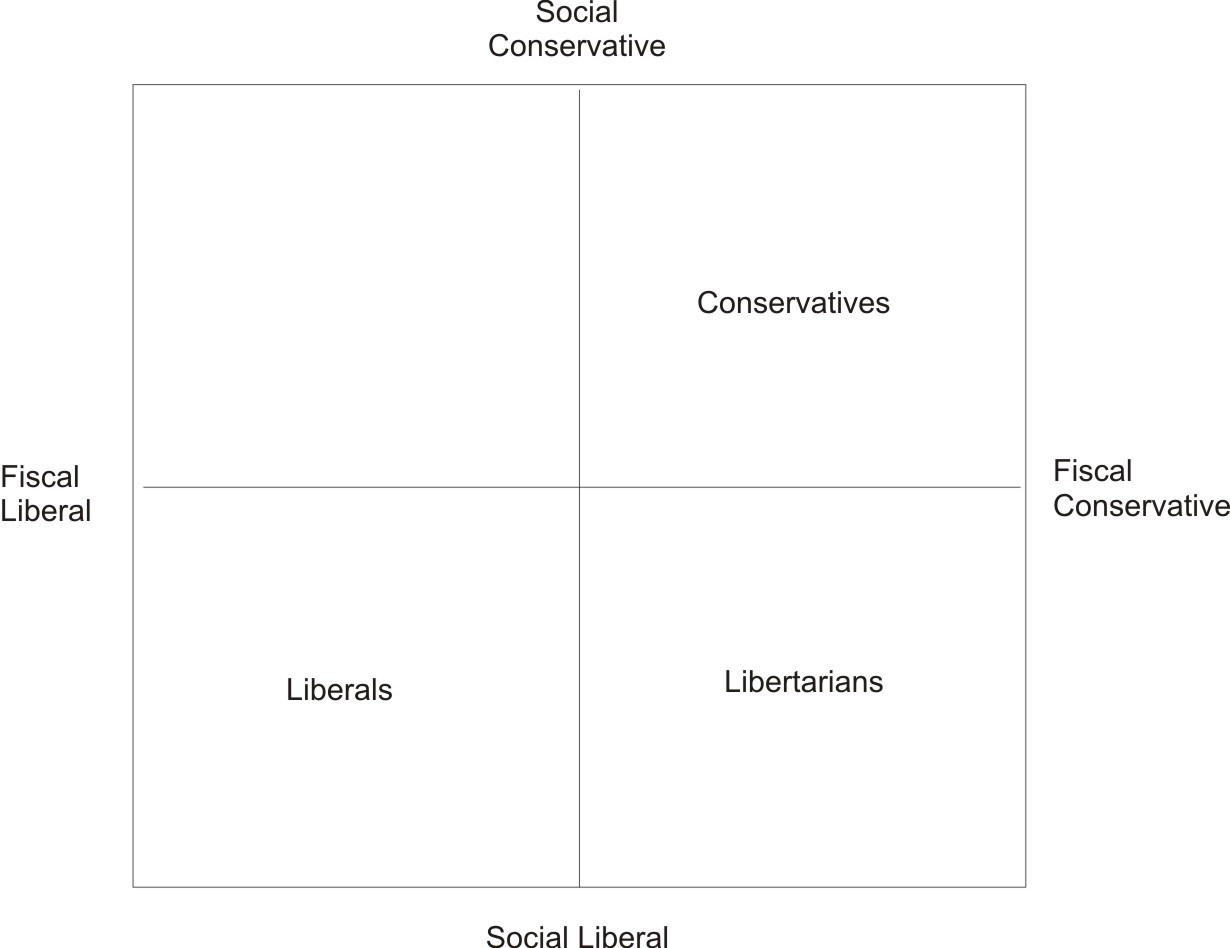
But this chart has its drawbacks, too. Some authoritarians, for example, are all for tradition, while others are for revolution. The religious right in the US is authoritarian to varying degrees about traditional values, but Stalin and Mao were authoritarian in a completely non-traditionalist way--they wanted to overturn the traditional order. The chart above can't capture that difference well, because it defines left and right in purely economic terms. Some people handle this by taking a slightly different perspective, and separating social views from fiscal views, as in the chart below. You hear libertarians in the United States saying they are fiscal conservatives and social liberals. A libertarian might be farther right than Ronald Reagan on economic issues, but couldn't care less about people's religion, sex life, or drug use.


But this chart still just shows two-dimensions.  To capture the traditionalism dimension as well as the authoritarianism/libertarianism dimension, and the left-right economic dimension, you would have to have a three-dimensional chart: a cube. But that would be hard to visualize.  Besides, what if we added another dimension? Nobody can visualize a four-dimensional chart. It's better to visualize more than two dimensions as shown below. Now we've upgraded the stupid little "tone" knob. Now we have an equalizer. We're Hi-Fi.


Now we can start to do justice to the range of views people really have, especially those who can't be accurately placed on the simple left-right spectrum (and most people can't). Here we can see how a moderate liberal who values civil liberties (me), compares to an authoritarian communist like Stalin. Regardless of what some people think about liberals, we're not that close:


Of course, there are many more factors that determine a person's politics than these three, and other ways of dividing them. The psychologist Jonathan Haidt has parsed political attitudes in a different way, along five different dimensions that affect peoples' political leanings: "1) harm/care, 2) fairness/reciprocity (including issues of rights), 3) ingroup/loyalty, 4) authority/respect, and 5) purity/sanctity".  (I described these in detail in this post). The "authority" dimension is similar to the one in the Political Compass chart above, but views on economic policy and traditionalism are divided into multiple other dimensions. In the chart below, we can see how American liberals, conservatives, libertarians, and Tea Party supporters differ on these dimensions.


Now, in all the charts above, we're talking about people's attitudes in general. We're not talking about particular political issues. But the traditional left-right spectrum fails us when it comes to those, too, as in the case of my gun-toting-but-otherwise-liberal friend. So why not divide those up too, and tackle each one on its own terms, rather than lumping them together? After all, why should your stance on abortion have anything to do with your stance on gun control, or gay marriage? Maybe a common set of values informs your opinions on all three, as it does for many in the religious right, or maybe it doesn't, as with libertarians.  It makes more sense to picture each issue as a separate knob on a political equalizer, like the one above, except with particular issues instead of general attitudes.


That's a whole lot more sophisticated than the left-right spectrum, to say nothing of the liberal vs. conservative dichotomy. But it's still a little too simple. Because if we focus in on most issues, we'll find that they are really a set of issues. For example, the range of possible views about abortion can't be captured by setting a knob somewhere along the pro-choice/pro-life axis. What about someone who is pro-choice up until the fetus can experience pain, and pro-life afterward? We would have to put such a person somewhere in the middle of the spectrum, but it would be more accurate to just have a more complex scale--an abortion attitudes equalizer, perhaps. Or maybe it would be better to forget the graphics at this point and describe in words the nuances of that person's belief.

That's the thing: all labels and graphics are limited. They're just maps, not the territory itself. The more detailed the map, the better (within reason), but no map captures the full complexity of the political landscape. Some may say we should keep things simple, and that all these nuances about politics are too complicated. Well, reality is complicated, and our political views need to be complicated enough to navigate that reality honestly, if not always effectively. People forget that. They forget that reality is more complicated than our simple dichotomies, and even our sophisticated charts. When they mistake the maps for reality, they start thinking reality is as simple as their maps are. It isn't.

Political labels tend to short-circuit independent thought. As soon as we label ourselves as liberals, conservatives, libertarians, or whatever, we're in danger of thinking: I'm a ___________ therefore I think ___________. That's backwards. What we should do is decide independently what we think about each issue, based on a careful consideration of the facts and arguments, instead of how we were raised, how we label ourselves, or what our friends think.

Of course, that's hard to do. We don't have time to research all the issues, we have different psychological predispositions and biases, and it's easier to follow a crowd and buy an ideology as a package deal. In fact, it's hard not to, because political groups have more to do with tribal loyalty than critical thinking. Whether you're part of the liberal tribe or the conservative tribe, tribalism is a powerful force. Break ranks on a hot issue, and you're sure to be criticized, and possibly ostracized.

These are all real issues, but none of them have much to do with truth. In fact, they all get in the way of it. Tribalism, in particular, is a lousy way of figuring out what's true and right. People should think very carefully before calling people traitors because they've drawn a different conclusion than the rest of their peers. No worthwhile ideology should seek to protect itself from dissent. If what we're seeking is truth, not ideology, the idea of betraying an ideology is nonsensical. Our loyalty should lie with truth, not ideology. If the ideology is wrong, we shouldn't believe it anymore. If we think something because someone tells us to, or because that's what people with our label are supposed to think, we're not actually thinking. We have to learn to think first, and apply labels second. Or maybe we should just ditch the labels altogether, so we'll remember to think for ourselves.

Tuesday, October 30, 2012

Taxes, Lies, and the King Kong Effect

 "Figures don't lie, but liars figure" - Some Unknown Sage

This morning I was reading about how you can lie--or at least mislead--with perfectly accurate numbers and graphics.  People commonly present accurate numbers in a way that gives a completely inaccurate impression.  The book I was reading quoted an editorial in 2003 by the Wall Street Journal which lamented the tax burden of wealthy Americans, saying, "taxpayers with incomes over $200,000 could expect on average to pay about $99,000 in taxes."

This is technically true, but entirely deceiving, because it implies that once you hit an income of $200,000, you can expect to make pay nearly half your income in taxes.  That's not true.  The figure of $99,000 is the average tax for everyone with an income of over $200,000--from a doctor who makes exactly $200,000 all the way up to Bill Gates and Warren Buffett.  These ultra-rich people pay millions in taxes, and that drives the average way up, even for people with very high incomes.  I had a professor in grad school who called this the King Kong effect.  If you took 14 normal-sized gorillas, and then King Kong, and computed the average weight of all 15 gorillas in your sample, your average would be a whole lot more than the average (normal) gorilla weighs, because King Kong is skewing the average.  In the same way, most people making around $200,000 per year (the gorillas) would pay much less than $99,000 in income taxes, and those with very highest incomes (the King Kongs) would pay far more.  And they will still be very, very rich.

But I don't want to suggest that only anti-tax crusaders play this game.  This afternoon, I saw this rather compelling video: Why Obama Now?  The video shows a figure based on the one below (I should point out that, while the video is based on a speech by President Obama, this graphic was not cited in the speech--I'm calling foul on the makers of the video and the graphic, not the speech the video is based on).

From ReadyThinkVote.com

Here we have people against tax cuts for the rich, using the same tactic used by the Wall Street Journal when arguing for those cuts.  But what is exaggerated here are tax cuts, not taxes.  A more honest chart would continue showing higher and higher incomes, instead of lumping vastly different incomes together on the right.  A chart like that would show a gradual rise in tax cuts with income, not a sudden jump at the top 1%.  Of course, if that chart were drawn to the same scale as this one, and included the highest-paid CEOs, it would be around 75 feet across.  Those folks get paid a lot.

But that's a whole other issue, and I want to be clear that this post isn't about taxes or income distribution.  It's about deception.  Statements like the Wall Street Journal's, and charts like the one above, are deceiving--whether deliberate or not, I don't know.  But whatever side of the tax issue you're on, I hope you'll agree that deception is wrong.  Truth is what matters, not ideology.  As far as I'm concerned, the whole point of having an ideology is that it reflects what I think is true and right.  If I have to resort to deception to serve my ideology, then I've lost sight of the truth.  And then I've missed the point entirely.

Friday, October 26, 2012

The Impostors of Reason


With its seven-inch wingspan, the owl butterfly is an impressive bug by any standard.  But what is really striking are its fake eyes.  It has eyespots on the underside of its wings, which mimic the eyes of an owl. Since owls prey on the birds that eat butterflies, the sight of those fake eyes is likely to give any would-be predator pause.  The butterfly is able to survive because the bird doesn't take the time to discover the deception. If the bird stopped and watched the butterfly for a while, it would realize how harmless it actually is. 

As for the owls it imitates, they have been symbols of wisdom and reason in western culture ever since the ancient Greeks associated them with Athena.  Owls actually aren't particularly wise or reasonable birds, but owls and reasoning do have one thing in common: they both have impostors.  The imposters of reason are things like anger, hard-heartedness, rudeness, and smugness.  People commonly mistake these things for rationality, when they're really nothing of the sort. They are impostors.  Like owl butterflies, they draw their power from shock and credulity. The more they're mistaken for the real thing, the more powerful they become.