Showing posts with label common ground. Show all posts

Sunday, January 6, 2013

Left, Right, and Other Directions: Getting Over One-Dimensional Politics

During the French Revolution, members of the National Assembly began to sort themselves according to their politics. Traditionalist supporters of king and church sat on the right, while those favoring radical ideas like establishing a more secular republic sat on the left. The terms "left" and "right" stuck, and today we talk about a political spectrum spanning the range from communism on the far left to fascism on the far right.


It's a strange idea, really. For one thing, the directions are completely arbitrary. If the members of the National Assembly had sat in a different arrangement, today we might be talking about far-left Republicans and far-right Democrats. Also, the idea of a political spectrum implies that political views are simple enough to plot along a single dimension, and that everyone's political views can be accurately plotted on that line. They can't. I have a friend who is an absolute fire-breathing liberal...except that he's against gun control. Where do you put him on that line? You can't. Like most people, he's simply not one-dimensional.

The political spectrum is a crude instrument. It reminds me of one of those cheap radios which, instead of having separate knobs for bass and treble, simply has one labeled "tone". Still, these days in the United States, even the idea of a political spectrum seems to be too subtle for some people. We've slipped into either/or, black/white thinking. The center has not held. It's given way to a sort of no man's land where people fear to venture, for fear of being called a traitor.  The other day, I picked up a recent issue of The American Spectator. The first article in the magazine referred to Chris Christie, the Republican governor of New Jersey, as "Judas" for saying nice things about how the Obama administration handled Hurricane Sandy. I've heard other moderate Republicans, like the Davids--Frum and Brookes--called traitors. Many on the right these days collapse everyone left of center into a big heap; lumping liberals, socialists, and even communists all together.

But liberals do the same things. Some of them see Obama as a traitor for some of his centrist--even right-leaning--policies (keeping Guantanamo Bay Prison open, for example). Some of them also consider it taboo to say nice things about the other side. I've had some very liberal friends get mad at me for saying far-right politicians might be decent people in some ways.

These days, in other words, we see politics less as a spectrum and more like this:


It's either/or. You're either a liberal or a conservative, in this view, and there's no room in the middle. It's like the tone dial on that cheap radio has gotten even less useful. It's become a switch, which forces you to choose bass or treble. If you try to step into the center, you'll find you have nowhere to stand. Move that way from either direction, and someone behind you will lump you with the other side and call you a traitor.

Maybe we should put the center back, and give it some respect. People tend to think of moderates as wishy-washy fencesitters. But that's not necessarily true. Some people carefully considere all the evidence for and against various issues, and the conclusions they draw happen to place them in the center. Those who think moderates must be too noncommittal to take a stand are subscribing to the simple-minded view that there are only two possible sides. Besides, moderation has a long and respectable history. As smart people like Aristotle and Buddha have reminded us, wisdom very often requires finding a balance between opposite extremes. Principled, thoughtful moderates should hold their head high, and tell both sides they have a right to be there.

But the center is a precarious place to be. It's less well-defined than left and right. Those in the center don't have a clearly defined group they can identify with, so there's a temptation to join one side or the other. Ideologues on both sides are suspicious of them. So, moderates can stay in the center and be glared at from both sides, or they can join a side and have clearly-defined allies. Contrary to the charges of wishy-washiness, it can be much more comfortable to take a side. In Elmer Kelton's Texas Ranger Trilogy, the sheriff trying to keep the peace says, "I'm just tryin' to stay in the middle ground". His wise preacher friend replies, "That can be the most dangerous place of all. People shoot at you from both sides."

With the human tendencies toward binary thinking and tribalism, being a moderate is like standing on a knife-edged ridge. If you're not careful, you'll roll down one side or the other, into one of the more well-defined groups. Maybe you'll have fiercer enemies then, but you'll also have fiercer friends. You'll have a well-defined identity, and a social support system. This may sound a bit like a slippery slope argument, but in this case the slope really is slippery. There's a lot of pressure to join one side or the other.


So, maybe instead of thinking in the binary bins of left and right, we should put the center back in its rightful, respectable place, as a well-defined group. Maybe this country needs a Moderate Party, so that the moderates have a place to call home.

Of course, this just divides the binary vision of politics into three categories--Left, Right, and Moderate--and that's still much too simplistic. It still lumps everyone on the right, and everyone on the left, together--as though there were no diversity on either side. But there's a great deal of diversity. Ronald Reagan was no Mussolini, and Barack Obama is no Lenin. People on both sides think there's a slippery slope from the moderate regions of the other side to the extreme regions. Some on the right, for example, think that if we institute universal healthcare, before long we'll be living in collective farms or gulags.

But I admit that as a moderate liberal, I've had the same thoughts in the opposite direction. George W. Bush really did remind me of Mussolini when he talked about the country "speaking with one voice". The little black bumper stickers that said "W. The President" scared me. I thought they smacked of fascism; of authoritarian ultra-nationalism and blind allegiance to a charismatic leader. I kept thinking of the quote attributed to Sinclair Lewis, "When fascism comes to America, it will be wrapped in the flag and carrying a cross". Still, I doubt that W was really an American fascist. I think he would have stopped at some point and said, "That's far enough". But I wish he had said so more often.

It seems that some people on the left see the political spectrum like this:


While some on the right see it like this:


The right sees the left on a slippery slope that could tumble into communism, and the left sees the right on a slippery slope to fascism. But neither slope is as slippery as the other side thinks. I tend to be fairly liberal, and many of my friends are more liberal than me. But none of them are communists. I've only ever met two communists, and that was in Canada.  Liberal or not, I didn't identify with them. In fact, I thought both of them were loud-mouthed fools. I don't think I know anybody who is even a socialist, if by "socialist" you mean someone who thinks "the state should own most means of production". Most liberals are just that: liberals. They're not socialists, much less communists. And most conservatives are conservatives. They're not closet fascists or Nazis.

There's a lot of diversity along the political spectrum, and in the United States today, it may be that the only slippery slope is away from the center. But even if we think in terms of a spectrum instead of a binary opposition, we're still just thinking in terms of one dimension, and that's just not enough. I started to realize this in college. That was the heyday of campus political correctness, in the early '90's. While I'm glad we no longer refer to humankind as "Man", sometimes this movement went too far. Liberalism was starting to turn away from freedom of speech more than I liked, and I started thinking of the political spectrum as a sort of circle, where the farther you got toward either extreme, the less you were interested in preserving freedom.

But I was still thinking in one-dimensional terms, as though there were some law of nature that says politics must be plotted on a single line, however slope-y or circular. It makes more sense to just add another dimension, as the people at PoliticalCompass.org have done. They have added a dimension of authoritarianism versus libertarianism.


This gives us a two-dimensional chart. The left-right axis charts economic attitudes: if you're for extensive government control of the economy, you're on the far left, and if you're all about free markets, then you're on the far right. But your place on that axis might have nothing to do with your views on personal freedom. Someone on the left or right economically could still be a strong believer in civil liberties. On this chart, Stalin would be in the upper left, while Hitler or Mussolini would be just right of center at the top. Someone like George W. Bush would be somewhere in the upper right, but (hopefully) not that close to Mussolini. American libertarians, who are usually all for personal freedom about things like sex, drugs, and religion, but also pro-free market, would be in the lower right hand corner. The traditional left-right spectrum can't do justice to libertarianism at all.

But this chart has its drawbacks, too. Some authoritarians, for example, are all for tradition, while others are for revolution. The religious right in the US is authoritarian to varying degrees about traditional values, but Stalin and Mao were authoritarian in a completely non-traditionalist way--they wanted to overturn the traditional order. The chart above can't capture that difference well, because it defines left and right in purely economic terms. Some people handle this by taking a slightly different perspective, and separating social views from fiscal views, as in the chart below. You hear libertarians in the United States saying they are fiscal conservatives and social liberals. A libertarian might be farther right than Ronald Reagan on economic issues, but couldn't care less about people's religion, sex life, or drug use.
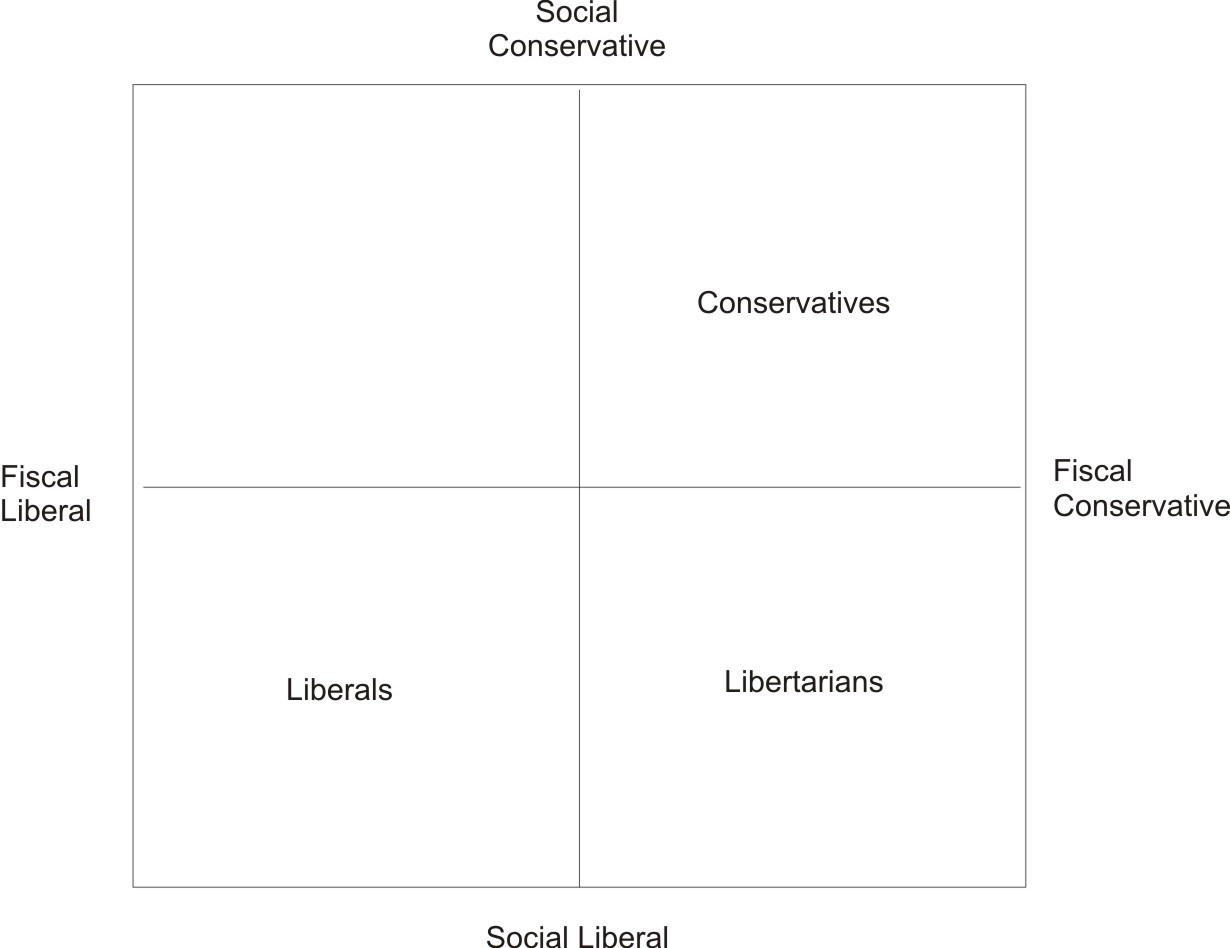

But this chart still just shows two-dimensions.  To capture the traditionalism dimension as well as the authoritarianism/libertarianism dimension, and the left-right economic dimension, you would have to have a three-dimensional chart: a cube. But that would be hard to visualize.  Besides, what if we added another dimension? Nobody can visualize a four-dimensional chart. It's better to visualize more than two dimensions as shown below. Now we've upgraded the stupid little "tone" knob. Now we have an equalizer. We're Hi-Fi.


Now we can start to do justice to the range of views people really have, especially those who can't be accurately placed on the simple left-right spectrum (and most people can't). Here we can see how a moderate liberal who values civil liberties (me), compares to an authoritarian communist like Stalin. Regardless of what some people think about liberals, we're not that close:


Of course, there are many more factors that determine a person's politics than these three, and other ways of dividing them. The psychologist Jonathan Haidt has parsed political attitudes in a different way, along five different dimensions that affect peoples' political leanings: "1) harm/care, 2) fairness/reciprocity (including issues of rights), 3) ingroup/loyalty, 4) authority/respect, and 5) purity/sanctity".  (I described these in detail in this post). The "authority" dimension is similar to the one in the Political Compass chart above, but views on economic policy and traditionalism are divided into multiple other dimensions. In the chart below, we can see how American liberals, conservatives, libertarians, and Tea Party supporters differ on these dimensions.


Now, in all the charts above, we're talking about people's attitudes in general. We're not talking about particular political issues. But the traditional left-right spectrum fails us when it comes to those, too, as in the case of my gun-toting-but-otherwise-liberal friend. So why not divide those up too, and tackle each one on its own terms, rather than lumping them together? After all, why should your stance on abortion have anything to do with your stance on gun control, or gay marriage? Maybe a common set of values informs your opinions on all three, as it does for many in the religious right, or maybe it doesn't, as with libertarians.  It makes more sense to picture each issue as a separate knob on a political equalizer, like the one above, except with particular issues instead of general attitudes.


That's a whole lot more sophisticated than the left-right spectrum, to say nothing of the liberal vs. conservative dichotomy. But it's still a little too simple. Because if we focus in on most issues, we'll find that they are really a set of issues. For example, the range of possible views about abortion can't be captured by setting a knob somewhere along the pro-choice/pro-life axis. What about someone who is pro-choice up until the fetus can experience pain, and pro-life afterward? We would have to put such a person somewhere in the middle of the spectrum, but it would be more accurate to just have a more complex scale--an abortion attitudes equalizer, perhaps. Or maybe it would be better to forget the graphics at this point and describe in words the nuances of that person's belief.

That's the thing: all labels and graphics are limited. They're just maps, not the territory itself. The more detailed the map, the better (within reason), but no map captures the full complexity of the political landscape. Some may say we should keep things simple, and that all these nuances about politics are too complicated. Well, reality is complicated, and our political views need to be complicated enough to navigate that reality honestly, if not always effectively. People forget that. They forget that reality is more complicated than our simple dichotomies, and even our sophisticated charts. When they mistake the maps for reality, they start thinking reality is as simple as their maps are. It isn't.

Political labels tend to short-circuit independent thought. As soon as we label ourselves as liberals, conservatives, libertarians, or whatever, we're in danger of thinking: I'm a ___________ therefore I think ___________. That's backwards. What we should do is decide independently what we think about each issue, based on a careful consideration of the facts and arguments, instead of how we were raised, how we label ourselves, or what our friends think.

Of course, that's hard to do. We don't have time to research all the issues, we have different psychological predispositions and biases, and it's easier to follow a crowd and buy an ideology as a package deal. In fact, it's hard not to, because political groups have more to do with tribal loyalty than critical thinking. Whether you're part of the liberal tribe or the conservative tribe, tribalism is a powerful force. Break ranks on a hot issue, and you're sure to be criticized, and possibly ostracized.

These are all real issues, but none of them have much to do with truth. In fact, they all get in the way of it. Tribalism, in particular, is a lousy way of figuring out what's true and right. People should think very carefully before calling people traitors because they've drawn a different conclusion than the rest of their peers. No worthwhile ideology should seek to protect itself from dissent. If what we're seeking is truth, not ideology, the idea of betraying an ideology is nonsensical. Our loyalty should lie with truth, not ideology. If the ideology is wrong, we shouldn't believe it anymore. If we think something because someone tells us to, or because that's what people with our label are supposed to think, we're not actually thinking. We have to learn to think first, and apply labels second. Or maybe we should just ditch the labels altogether, so we'll remember to think for ourselves.

Saturday, October 6, 2012

What We Think and Why: Two Guests Explain Their Political Beliefs

For this post, I'm just going to come to the podium, introduce the topic being discussed, and then shut up and listen while other people get up and talk.  I've always been amazed by how much people misunderstand each other.  We tend to think those on the opposite end of the political spectrum are more extreme, more sinister, and less intelligent than they really are. We think they do what they do because they're mean and stupid, when in fact, they're often doing it because they genuinely think it's the right thing to do.  And they think we're mean and stupid.

Now that social media has come along, I think we're missing a great opportunity to explain to other people what we really think, and just as importantly, why we think it.  Of course, what people usually do when politics comes up on social media sites is to take sides and have a big, playground feud with name-calling, scapegoating, and hurt feelings all around.  But surely it doesn't have to be this way. At least, maybe we can use it to increase understanding, too.  So, I put together an online survey asking people to briefly explain--in the most polite, thoughtful way possible--what their political beliefs are, and why they believe them.  I also asked them if areas where the other side has a point, how they are most commonly misunderstood, and how they think public debate could be made more civil and productive.  So far, the volume of responses has been underwhelming (2 people), but the quality has been excellent.  One is a moderate, and the other is a moderate liberal. If you read these, and feel like explaining why you believe what you do, I'm linking to the survey at the bottom. If I get some more responses, I'll post them here.  It would be nice to get some other views, especially conservative and libertarian ones.  And now, I'll yield the floor to my guests.

First Guest (Moderate)

1. Where do you live?
Arkansas

2. How would you describe your political views?
Moderate

3. How would you describe your religious beliefs?
Christian (Protestant)
I'm a Christian who thinks many modern interpretations of Christianity are off in a significant way.

4. Please briefly describe your basic views about politics. Try to politely explain what you believe, and why. Please be as clear and specific as possible. If you say you believe something, please explain why you believe it. Be friendly! This is not the place to say why the other side is wrong. The point is not to convince others you're right, but to help them understand how you see things.

I think both sides of any political argument can usually learn something from the other, and the reason our country's so divisive is there's not enough respect for our collective differences. The truth is often found somewhere in between. I think each extreme stance is a direct response to the opposite extreme and that both extremes have way more in common than they'd care to admit. I think there's a difference between standing up for your beliefs (i.e. living your life according to your moral code) and denying someone else the right to theirs because of what you believe. Or at least, there should be a difference. I think science and theology aren't mutually exclusive. I think Christians' (or any faith's) refusal to acknowledge scientific advancements or to accept current scientific understanding is killing religious faith. I also believe that scientific arrogance is triggering that response. The only things science proves are the scientific reasons or causes of things in our physical world. It's not within the purview of science to disprove matters of faith and I believe scientists who claim otherwise are overstepping their boundaries. I also believe extreme conservative Christians who refuse to consider different interpretations of the Bible will eventually render their own faith obsolete. There's no reason our understanding or perception of God can't grow with our understanding of science and perception of the world in which we live. I believe God doesn't allow bad things to happen to good people. I believe we live in a physical world where natural things happen, and I believe each of us has been given the gift of free will. I believe that free will often results in people making poor decisions, which then have a negative (and sometimes devastating) effect on others. It's up to each of us to choose how to respond and grow from those experiences. I believe that what I believe doesn't really matter to anyone besides myself, my family and friends, and anyone upon whom I have the opportunity to have an impact. I believe my beliefs have more impact if I reserve them for when they really matter instead of waving them around like a showy flag. I believe I should leave a positive impact on this world and show respect for others. I believe this is a brilliant idea.

5. How do you feel that others most commonly misjudge your views? In other words, what are the biggest misconceptions or misunderstandings others have about people with your political views?

My conservative friends think I'm delusional and that I've lost touch with my beliefs when I voice a liberal stance on something they perceive as "un-Christian." My liberal friends think I'm ignorant or obviously closed-minded when I voice a conservative stance something.

6. Please rate how important you consider each of the issues below. If there are other issues you find important, please list them in the "Other" section.


Very Important (1) Important (2) Somewhat Important (3) Not Very Important (4) Unimportant (5)

Abortion
X


Crime

X


Economy and Jobs
X


Education
X


Environment
X


Ethnic Minority Issues

X


Foreign Relations
X


Gay Issues and Gay Marriage
X


Gender Issues


X

Global Issues
X


Government Spending

X


Gun Policy


X


Terrorism

X


Other (please specify):

7. Please list the top one to three political issues that are most important to you, and explain what you believe about them, and your reasons for those beliefs. Please remember that the point is not to prove you're right, but to explain your views to people who don't share them.

Abortion - I personally don't believe my life is my own. I believe I have a responsibility to make loving choices in everything I do and to accept responsibility for my actions. I don't always succeed but I must always strive. I believe there are natural consequences to all that we do, and one of the potential natural consequences of sex is pregnancy. As a woman, I believe we make our choice when we decide to have sex. If pregnancy results, it's our responsibility to make a loving choice and if we're not prepared to keep the baby, maybe the father is. If not, there are many adoption options. I believe abortion should be reserved for victims of rape and incest, though I admit proving who's a victim and who's not isn't always easy. Having said all this, I also believe both sides of this debate miss HUGE opportunities to work together to prevent the need for the argument in the first place. Sex Education and Personal Responsibility classes could go a long way toward that goal. Gay Issues and Gay Marriage - I believe conservative Christians are way off base here, and I believe how this debate turns out could have a huge impact on human rights in general. I don't believe the government has the right to restrict gay marriage rights any more than I believe they have the right to restrict mine. I don't think it matters whether you believe gay men and women were born gay or whether you believe they choose to be gay. The point is they should have the choice to be happy regardless of WHY that makes them happy. I have a dear friend who believes to the core that gay people shouldn't be allowed to marry because it's not Biblical, but in the next breath she'll state she wants a government whose role in her life is restricted in order to protect her rights as a human being. This woman is brilliant in so many ways yet she has no idea how contradictory these two stances are. Education - I believe education is the key to pretty much everything.

8. Are there areas where you think people of different political views might have a good point? If so, please explain.

Being the moderate that I am, I almost always see both sides of the argument. I may come down on one side of the fence over the other, but I can usually see the other point and find some truth in it.

9. Do you think there is too much partisanship or incivility in public debate? If so, do you have any suggestions for ways we could make public debate more constructive? Are there any other points you would like to make about this issue?

There's definitely too much partisanship and incivility in public debate. We could start by respecting our neighbors more. Insist on being right less often. Admit when we're wrong. Not that I'm always good at it because I do have a fair amount of pride, but I try to see reason in the end because I despise arrogance.

___________________________________________________

Second Guest (Moderately Liberal)

1. Where do you live?
Arkansas

2. How would you describe your political views?
Moderately Liberal

3. How would you describe your religious beliefs?
Christian agnostic

4. Please briefly describe your basic views about politics. Try to politely explain what you believe, and why. Please be as clear and specific as possible. If you say you believe something, please explain why you believe it. Be friendly! This is not the place to say why the other side is wrong. The point is not to convince others you're right, but to help them understand how you see things.

I believe that politics are corrupted by money and always have been, but that the Supreme Court's granting of personhood status to corporations has led to a supernova of corruption which threatens our entire nation. The current political atmosphere is poisonous to any sort of cooperation and accomplishment, and ensures that lawmakers spend more and more time raising money and less and less time representing their constituents. It's crucial that leaders on both sides begin to cooperate even if it means that they don't get re-elected. If they were the public servants they claim to be, they would care less about re-election than about doing what is right. Vick Snyder is a wonderful example of what a true public servant should be. I don't believe that continuing extreme tax breaks for the rich and for corporations has been or will be effective at increasing jobs. It's been tried and has only made things worse. Our political campaigns last far too long and spend an obscene amount of money. I firmly believe in separation of church and state, both for the protection of the state and for the protection of religious freedom. Anytime a given group's religious beliefs and practices are accepted as part of the state, other religious beliefs and practices are automatically discriminated against. This is completely un-American in my opinion. I think that the U.S. offensive war in Iraq was a terrible mistake which has cost our country dearly and which helped to sink our economy to a sorry state. Deregulation of the banking industry was also a terrible mistake, for which both parties are to blame. Once again the corrupting influence of big money. I believe that true leaders must stand up and do everything in their power to turn environmental destruction around before it's too late. True patriots do not object to paying reasonable taxes to support national infrastructure, defense, our elderly, etc. Every effort should be made to stop fraud and waste, but we must take care of the nation and its people, and the very wealthy should pay their fair share.

5. How do you feel that others most commonly misjudge your views? In other words, what are the biggest misconceptions or misunderstandings others have about people with your political views?

In this part of the country, people with my political views are probably considered radical and deluded. Many people think that any degree of liberalism is somehow anti-Christian, when in fact, many Christians believe that Christ would be classified as a liberal if he were on Earth today. Anything other than conservatism is viewed as "bleeding-heart", and wanting to give away hard-earned money to lazy people. I think most conservatives believe that there are huge numbers of free-loaders getting "welfare" and that the U.S. gives away a large part of its wealth in foreign aid because of liberals. In fact, what most people think of as "welfare" doesn't exist anymore except in cases where children are concerned, and foreign aid is a small part of our budget. Conservatives seem to think of liberals as immoral hippies who want a Marxist government. I think one of the biggest misconceptions people have about people who support Pres. Obama as I do, is that we have been taken in by a Black Muslim who wants to destroy America.

6. Please rate how important you consider each of the issues below. If there are other issues you find important, please list them in the "Other" section.


Very Important (1) Important (2) Somewhat Important (3) Not Very Important (4) Unimportant (5)
Abortion

X

Crime
X


Economy and Jobs X


Education X


Environment X


Ethnic Minority Issues
X


Foreign Relations
X


Gay Issues and Gay Marriage

X

Gender Issues
X


Global Issues
X


Government Spending
X


Gun Policy
X


Terrorism
X


Other (please specify): Unlimited political contributions, especially by corporations.

7. Please list the top one to three political issues that are most important to you, and explain what you believe about them, and your reasons for those beliefs. Please remember that the point is not to prove you're right, but to explain your views to people who don't share them.

1. Environment- I put this first because if we destroy the environment, none of the other issues will matter in the long run. 2. Economy and jobs-When people are unemployed and/or financially insecure, they are easy prey for demagogues who can stir them into irrational and dangerous actions. If the economy is not healthy, every other aspect of society suffers. 3. Education--Education is essential to the future of the nation and it's people. We have to have people who are educated to play a productive part in the modern world and we can't allow ourselves to fall even farther behind other developed nations. Educated people are able to make better choices for their own lives and thus for the nation as a whole. They have more stable families, and live longer, healthier lives.

8. Are there areas where you think people of different political views might have a good point? If so, please explain.

I think it is true that there are people who cheat the system, and that we need better ways of detecting fraud of all sorts.Of course, there is government waste which needs to be addressed by honing in on specifics. I think the conservative idea that single-parent families are less likely to succeed is true because common sense and valid research both support this. I think that the conservative idea that people should show individual responsibility by buying health insurance if possible is a good one, though conservative leaders now disown the idea they came up with.

9. Do you think there is too much partisanship or incivility in public debate? If so, do you have any suggestions for ways we could make public debate more constructive? Are there any other points you would like to make about this issue?

Yes, there is far too much of both. We could make public debate (pre-planned debates) more constructive if we agreed to have all questions independently fact-checked before the debate and if those facts were distributed to both the audience and the debaters beforehand. Otherwise, things can only improve if reasonable people of all beliefs push vocally for a more civil and fact-based discourse. Extremists of all stripes do vast harm to civil discourse. Educating people in recognizing propaganda techniques along with critical thinking skills would help to defeat those who make a living keeping the public stirred up with lies and hate-speech. Better science education would help people to understand issues concerning the environment, health care, and research.

____________________________________________________
Thanks to my guests for their thoughtful responses!

Click here to take survey


Saturday, August 4, 2012

Memo: Keep Up the Good Work

To: Ministry of Communication

Dear Colleagues:

The Director has been following your recent work, and is very pleased with the quality of public debate you've helped promote in the United States. Social networking sites have been a godsend to us (if you'll pardon the expression). However, we've become aware of a small but troubling movement calling for “civil public debate.” As this yawn-inducing phrase indicates, the movement isn't exactly capturing the public imagination. Indeed, its commitment to restraint, modesty, and rationality should insure its failure. It doesn't appeal to the more primal emotions, and should therefore be no match for our more robust methods.

Still, the Director feels that if the civility advocates learn to spread their message effectively, they could be a thorn in our side. As a countermeasure, we have prepared a message to be funneled to our contacts in both American political parties.
Dear friends,

With all the progress we've made against our opponents, we have good reasons to congratulate ourselves. Our courage and zeal have paid off--just look how mad the other guys are! They're really starting to hate out guts.
But there are people questioning our success.  They claim the rhetoric is getting too heated, and they're calling for “civility." Folks, we can't let this kind of thinking slow us down. Our progress so far has been based on untempered passion and self-assurance. Now these civility advocates are bleating about how “complex” reality is, and how we need to be more “reasonable.” Well, when have our opponents ever been reasonable with us? This talk of moderation will only let them get the upper hand. Our country is like a house on fire, and we have to fight fire with fire.
So forget this stuff about reality being complex. What we need are simple, catchy slogans. We need punchy one-liners. We need talking points we can repeat until we don't even need to think about them anymore. Logic and science are fine when they tell us what we want to hear, but they just don't light a fire under people. We also need good, solid denunciations. We need boogiemen. That's why we have to get out there on Facebook and Twitter and keep the fear and loathing hot. If you're going to snipe at someone, don't just say it; say it with feeling. Use multiple exclamation marks; and don't be afraid of the caps lock button. A SENTENCE LIKE THIS SHOWS HOW PASSIONATE YOU ARE, AND IF YOU'RE PASSIONATE, YOU MUST BE RIGHT!!!!!
Try to make converts if you can. As soon as someone changes their mind and joins us, they become one of the Good Guys.  So get out there and argue. Everybody knows there's no better way to convince someone than saying what an idiot they are in front of as many people as possible. If it didn't work, why would so many people try it? If your opponent hasn't seen the light, a few more good insults will usually bring them around.

Of course, some people are hard-headed, and won't believe you no matter how stupid you say they are. If they absolutely won't listen, just ask yourself this: were you really trying to convince them anyway? Of course not. You were trying to make US look smart, and THEM look bad. And that's OK, because we are smart and they are bad. Otherwise they would agree with us!

Most people aren't going to change their minds about anything, regardless of the evidence. Do we? Absolutely not! Still, we can't let our friends be lured to the dark side. That's why we need more preaching to the choir. We need more bandwagons; more strength in numbers. It takes real courage to stand up for something when all your friends do, too.

Some will claim we should be fair-minded and truthful, but how can we, if the other side won't? This is like a nuclear arms race, and some things you have to see through to the bitter end. We have to embrace vital rhetorical tools like hyperbole, rumor, and wild accusation. It's amazing what people will believe. They'll even spread the message if you phrase the email correctly. Don't worry...most people have never even heard of Snopes.com.
If you run into one of those irritating people who make calm, thoughtful points, just throw up a straw-man caricature of their argument and kick the stuffing out of it. And never underestimate the power of simpler forms of ridicule. A good horse laugh has stopped many an argument in its tracks. Finally, never attack someone's argument if you can just attack them. Do they look funny? Point it out. Some say ad hominem attacks like that are fallacies. Maybe, but a good fallacy can get you a long way in today's world.

Finally, don't worry about making people so mad they'll get violent. It's not like you're looking them in the eye. This is the age of the internet--just insult the ones that live far away from you; that's the safest thing. They probably won't take it out on anyone else. The bottom line is, there may be risks associated with the kind of robust public debate we're advocating, but they're worth it. Our side has everything to gain, and our opponents have everything to lose. People who say we should find common ground have their heads in the clouds. Besides, it's not like Americans would ever actually go to war against each other.
Feel free to modify this message as you see fit.  However, this may not be necessary, as it was written by the Director himself.  He has thousands of years of experience at this sort of thing, and his track record speaks for itself.

From:  Office of the Director
One Ninth Circle
Hell

Saturday, July 28, 2012

Insults and Arguments: Why We Need to Do Better


"There's a mighty big difference between good, sound reasons and reasons that sound good." -Burton Hillis
"We're not enemies, we just disagree."  - The Strokes, Is This It
I'm going to try to make this post entertaining, but the cards are stacked against me. Here's the problem:  I want to be as thoughtful, logical and accurate as possible.  Those things, sadly, don't have much entertainment value. It's a shame, but there you are.  Humor, satire, clever metaphors, hyperbole--those things are entertaining, and they may even lend themselves to deep insights, but they aren't particularly logical or precise. Maybe that's why people like them--logic and precision are dry things. Necessary, but dry.

That's a bitter pill, for those of us who try (try I said) to see the world clearly and rationally, while avoiding being boring or pedantic.  The more we try to be thoughtful and clearheaded, the less entertaining we're likely to be.  Even worse, if we get in a public debate with someone, we may be completely in the right, but if they're more entertaining, they are probably going to be judged the winner.  And it's easier to be entertaining when you're not worried about being accurate.  Never debate a good comedian. You won't win, even if you're right.  At least, not in the eyes of most crowds. 

I learned this lesson years ago, back when I was trying to be a writer and was correspondingly underemployed.  I had signed up with a temp agency, and one day I found myself working for a Sikh trader in oriental rugs, whose first name, I recall, was Surender.  Surender was rearranging the rugs in his warehouse, and he had a whole team of temp workers rolling them up and moving them around (this was amazingly demanding--you don't realize how heavy rugs are until you move them around all day long).  Four of the other temp workers were dodgy sorts, with jailhouse tattoos and jailhouse attitudes.  From their conversation, they seem to have known each other in jail.  Anyway, one of them was an accomplished loudmouth, swearing like a stevedore and bossing everybody else around (in hindsight, I realize he was probably on a roaring meth buzz).  I think he had worked there a couple of days already, so he considered himself an expert at the rug-shifting game.  When he gave me one order too many, I said, "Hold on. Why are bossing everybody around?  How long have you been here?"  Everyone else stopped and looked at us.  He eyed me and said, "How long have I been where? On Earth?!"  The rest of the ex-cons laughed like that was the funniest thing ever said.  "Burn!!"  "Good one, dude! Tell him!".  Everybody else laughed along nervously, and kept folding rugs and taking orders.

I lost that argument.  Not because I didn't have a point.  I did, and some of the other guys agreed with me. I lost because my opponent had been judged the wittiest, by a jury of his peers.* It was embarrassing, but I had learned a good lesson.  The person who makes the most entertaining remarks, or seems sympathetic to the most observers, generally wins a public debate--at least in the eyes of the public.  Their opponent may be more reasonable, and may even be right, but that doesn't matter.  If you come off looking tongue-tied, or stiff, or pretentious, you lose.

Obviously, this is a problem, because wrong is still wrong, even if it makes the crowd go wild.  If someone give the most eloquent, memorable speech ever, extolling the benefits of drinking strychnine, that doesn't make strychnine good for you. If the people in the crowd rush home and make strychnine tea, most of them will die, no matter how convincing the speech was.  If this weren't true--if facts and truth didn't matter--then it would be fine that glibness convinces more people than reason.  But they do matter, so it isn't fine.

But what can be done?  The only solution, I think, is to educate as many people as possible about what makes a statement truly convincing, and what just makes it seem convincing.  In other words, people need to know what constitutes a valid argument, and what constitutes a fallacious or invalid one.  I'm using the word "argument" in a particular way here.  I don't mean it in the sense of "verbal conflict".  Logically speaking, an argument is a claim that is supported with other claims.  The main claim is called a conclusion, and the supporting claims are called premises.  When you give an argument, you don't just state your conclusion.  You state your premises, too:  the reasons, or evidence, that supports your conclusion.  If I say, "Bernie Madoff is a swindler", that is true, but it isn't an argument.  To make it an argument, I would have to offer facts about the Ponzi schemes he was running, and how many people they ruined.  A naked claim, with no evidence to back it up, doesn't give you any reason to believe it.  If a stranger walked up to you and said "Bernie Madoff is a swindler", and you had never heard of Bernie Madoff, you would have no particular reason to believe him.

Once you explain what arguments are, it's easy to see why they're essential in a debate.  Strangely, though, most of the statements in a debate aren't arguments. Think about the debates you've seen break out in online comment threads.  You've almost certainly seen insults (You liberals are a bunch of idiots), jokes (If Obama came out for oxygen, Republicans would stop breathing), ridicule (Nobody with any sense believes that), demonization (Republicans love it when homeless people die in the gutter), cheerleading for your side (I'm a conservative and proud of it!), and old-fashioned, meaningless verbal abuse (Screw you!).  Actual arguments, where someone makes a claim and then backs it up with reasons or statistics, are the exceptions to the rule in most debates (just look at an online debate and see how many you can find).  Even when people do offer actual arguments, many of them are invalid, because they commit one fallacy or another.  Their premises are wrong, or irrelevant, or their conclusions don't follow from their premises.  Most debates online are like a Three Stooges fight, all eye-poking and ear-pulling.  They're noisy, and they entertain some people, but they don't prove a thing, except possibly who can gouge eyes with the most flair.

If most of the statements people make in a debate have no bearing on whether the idea being debated is true or false, because they offer no evidence for or against it...why do people make them?  I think it's because finding the truth isn't peoples' main goal in a debate. The real (if unconscious) goals for most of us are things like showing people how smart we are, convincing our opponents we're right (and how often does that happen?), making our opponents look bad, displaying support for our side, and so on. 

Of course, most people don't admit these things to themselves. They think they already have the truth, and that they're defending it when they debate.  This means they don't see a debate as an interaction that might bring all parties closer to the truth.  They think they're already there.  Maybe that's why many people don't put a lot of thought into whether the things they are saying are valid arguments. That rarely occurs to them, because they take it for granted that they know what's really true.  Why worry about giving valid reasons for your claims when you know you're right?  Why not spend your time trying to sound smart, and making the other side look bad? Especially when many of the people watching the debate think that insults, ridicule, and fallacies are just as compelling as valid arguments, if not more so. They're more likely to be vivid and memorable, after all.

Why are people so...unreasonable? I think it's because most of us have far too much faith in our ability to see the world as it really is. Human senses are weak, and the human mind is amazingly error-prone. Think about basic sensory perception, and how limited it really is. We can see only a thin slice of a vast spectrum of electromagnetic radiation.  Our eyes can detect red, green, and blue light, but not infrared or ultraviolet, to say nothing of radio waves and x-rays.  Similarly, we can only hear a thin slice of the spectrum of sound waves out there.  Elephants communicate in deep rumbles that carry for miles, but we can't hear them, because they are too low-pitched for our ears.  Not only are our perceptions limited, but we make sense of what we do perceive by bending it to fit with what we already know or believe.  People fall prey to all sorts of perceptual illusions, cognitive biases, and fallacies of reasoning.  If you start looking up these mental pitfalls, you'll find there are hundreds of them. Can you really be that sure you're right, when there are so many ways to be wrong?

Not only is it easy to misinterpret the evidence of our senses, but for many of us, evidence isn't even what's important. People quite often hold beliefs for reasons that have very little to do with how much evidence they have for them.  People may accept a belief because:
  • They grew up believing it.
  • Their friends and the people they identify with believe it.
  • It makes them feel good.
What would make the most sense, when deciding what to believe, is to first look at the evidence, and then decide what you think is true.  That's not what people do most of the time. They get their beliefs from others, and then they look for arguments that support them, and ignore arguments that don't. They associate with people who share their beliefs, and tend to avoid or even demonize those who question them. Liberals read liberal magazines and nod along, and conservatives do the same thing with conservative magazines. It's more comfortable that way.

We all do these things, to some extent.  We do them because, even though we're prolific in our errors, we're passionate in our beliefs. We get upset when our beliefs are questioned.  We'll defend some of them to our last breath, even though we are fairly likely to be wrong.  In fact, some of the ideas with the least evidence to support them are the ones people kill each other for the most. It's one of the great absurdities of humankind, but there it is.

So, how do we get out of this mess? How do we stop being so silly?

I think we should start by taking hard look at ourselves, and admitting just how silly we've been. We should admit how error-prone we are, and that we might be wrong. We should take another look at the way we argue with others. If we could just admit that we might be wrong--that the "truths" we are defending might not be unassailable--then maybe we could admit that we are going about debate in the wrong way.  Maybe, for example, we actually need to give reasons for our claims, instead of squawking and jeering and saying that whoever doesn't believe us is a fool or a villain. If we decide that the purpose of debate isn't to prove we are right, but to discuss things until we all get closer to what is true, then maybe we should listen more to our opponents. Lots of them are smarter than we think. Perhaps we should interpret their arguments charitably, instead of caricaturing them. When they make a good point, we should acknowledge it. When they point out a flaw in our own reasoning, maybe we should actually admit it, and even (gasp) thank them for pointing out our mistake.  Maybe we should de-escalate the discussion when it gets heated, so that everyone keeps listening and learning from each other. 

I think these are all worthy ideas, but the main point I want to make in this essay is that we need to learn the difference between a real argument and its imitators. We need to spot fallacious reasoning in others, but we also need to spot it in ourselves (this is harder, because of our self-serving biases, which means it really is easier for other people to point them out). One way to start is by reading about cognitive biases and logical fallacies, and learning to watch for them (and not just in other people). I've listed some good places to start in the links below.

Of course, it's no easy thing to recognize the flaws in our own thinking.  And it may even be thankless. You may think, "What's the point of improving my reasoning--trading insults and fallacies for good arguments--if so many people out there are convinced by bad reasons, and wouldn't know valid reasoning if it mugged them in the street? If I debate someone funnier than me, and everyone decides the funny guy won, then what's the use?"

All I can offer is that the truth matters. Honesty matters. Striving for reasonable debate--and against unnecessary, childish squabbling--matters. That's why it's not enough just to improve our own reasoning. We have to convince others to recognize good reasoning, so that it gains more widespread respect, and bad reasoning loses it. We need more people to be able to recognize the difference between an unfounded assertion and a well-supported one. We need people to know the difference between a satirical jab, hilarious as it may be, and a plain, honest, valid point. Of course we're never going to show everyone how to think and debate intelligently. But the more people learn how, the better off we'll all be.
________________________________________________________

A Rulebook for Arguments. Anthony Weston.  A good, concise guide to arguments and critical thinking.


Rhetological Fallacies:  An infographic from Information is Beautiful

Thou Shalt Not Commit Logical Fallacies:  Has a nice, printable poster about fallacies.


 * I did get the last laugh.  Later that day, I noticed the bossy comedian was gone.  I asked Surender where he was, and he raised an eyebrow and said, "He had a foul mouth.  He had to go".

Friday, October 14, 2011

The Blind Men and the Elephant: Why We Need to Change How We Debate


When I see people having angry debates (or when I cool down after getting into one) it always strikes me that we need to reframe how we see the purpose of a debate.  People tend to approach a debate as a winner-take-all game that you either win or lose, instead of a way to collaboratively search for the real truth.  Most people have their point of view, which they take for granted to be correct, and they try to prove how it's better than their opponent's point of view.  Oftentimes, both sides lose their cool and start needling or insulting each other, trying to make the other side look stupid.  If each side represents an ideological group (say, American liberals and conservatives), each group is turned into a sinister caricature of itself by the other side--stupider, meaner, and more extreme than most of them really are.  There are a whole bunch of problems with this approach:

·         People are much too confident they are right.  Human understanding is pretty error-prone.  Our feeble senses pick up thin slices of a complex world, and we use our limited brains to try to put these slices together into an accurate picture, based on our past experience.  Our understanding at best limited and at worst flat wrong.  Nevertheless, we get emotionally attached to our grasp of reality.  So, the views that we get red-faced defending are quite likely to be inaccurate.

·         Insults, rants, needling, and caricatures only convince those who agree with them in the first place.  No self-respecting person is going to listen to someone tell them how stupid and wrong they are, and think "OK, I guess you're right".  The more measured and polite your argument is, the more likely it is to be convincing to someone who doesn't agree with it.  This may seem pretty obvious, but it's very hard to remember in the heat of debate.  It never seems to have occurred to some people at all.  The point is, even if your goal is to win a debate, then getting angry and insulting is a bad approach. Of course, this assumes that your idea of winning a debate is convincing your opponent.  If your idea of winning is to thoroughly insult and humiliate your opponent, it might work.  That's a common goal, but is it a worthy one?  I mean, Galileo was insulted and humiliated, but he was still right.

·         Most people are at least partly right.  We tend to treat people who disagree with us as if they were wrong...period.  Sometimes that's true, but oftentimes it's not.  If you're a conservative, and a liberal tells you it's easier to make money if you already have money--they're right.  If you're a liberal, and a conservative tells you there are freeloaders who leech off the system--they're right, too. 

·         Lots of people who don't agree with us turn out to be fairly intelligent and moral.  Even if someone has a belief you find repulsive and immoral, they are likely to be a decent person in other ways.  This seems obvious...if it's someone you know well.  "Well, Uncle George is racist, and that's disgusting, but he would do anything for his friends and family, and he's really smart about a lot of things".  That doesn't work if you don't know the person well.  "That George guy is a racist.  He's a complete maggot".  The problem with turning people into sinister, stupid, repulsive caricatures based on unsavory characteristics is: 1. It's inaccurate.  2. Deciding a person, or group of people, is bad through-and-through is the first step people take toward killing them.  Maybe that's a slippery slope argument, but that slope really can be slippery, because nasty arguments are self-reinforcing.  They have a tendency to escalate into even nastier arguments.  Push comes to shove.  When you hear someone talking about "idiot libtards" or "rethuglicans", it's not that hard to imagine them contemplating violence.

·         If it's common for people to be partly right, then the point of most debates should to compare notes, and try to work out the bigger picture each person is only partly seeing.  This is the point of great story Buddhists and Sufis like to tell:  A group of blind men, who have never heard of elephants, is given a chance to go and touch one for a few seconds.  One feels the trunk, and thinks an elephant must be a lot like a snake.  Another feels a leg, and decides it must be like a pillar.  One feels its tusks, and decides that it has horns, like a cow.  When the blind men start talking about the elephant, they immediately start arguing, each insisting that his impression is the right one.  Finally, they walk away from each other, muttering darkly about what idiots the others are.  What they should have done, clearly, is to be civil and compare notes.  If they had talked it over for a while, accepting that reality is bigger and more complicated than their simple impressions, they would have gotten a much better idea about elephants.  Let me be clear, though:  I'm not arguing for absolute "reality-is-socially-constructed" relativism here.  There really is an elephant, whether any blind men fondle it or not.  In real life, everyone isn't always partly right.  If someone tells you the earth is flat, they are wrong, period.  This is the blind man who never touches the elephant at all (perhaps because he's sure he knows what an elephant is).  People can certainly be plain wrong, but my point is that our intellectual opponents are partly right far more often than we give them credit for.  Reality is a big, weird elephant.  Nobody understands completely, but most people manage to touch it occasionally.

My point here is that we need to change how we see the goals of a debate.  It doesn't need to be a winner-take-all game.  Most debates can be win-win if we can be respectful, and if we can consider the possibility that we might be partly wrong, and our opponents partly right.  Even if we're completely right, we're more likely to convince our opponents if we're reasonable and polite.  Relating to people we don't agree with by vilifying and insulting them is, in a word, stupid. It's not just childish; it's actually irrational, because it's counterproductive.  If I decide I can't possibly be wrong, and that my opponents are all mean-spirited idiots who deserve nothing more than to be put in their place, I'm taking the lowest road I can find.  There are higher roads, and we need to make better use of them.