Sunday, January 6, 2013

Left, Right, and Other Directions: Getting Over One-Dimensional Politics

During the French Revolution, members of the National Assembly began to sort themselves according to their politics. Traditionalist supporters of king and church sat on the right, while those favoring radical ideas like establishing a more secular republic sat on the left. The terms "left" and "right" stuck, and today we talk about a political spectrum spanning the range from communism on the far left to fascism on the far right.


It's a strange idea, really. For one thing, the directions are completely arbitrary. If the members of the National Assembly had sat in a different arrangement, today we might be talking about far-left Republicans and far-right Democrats. Also, the idea of a political spectrum implies that political views are simple enough to plot along a single dimension, and that everyone's political views can be accurately plotted on that line. They can't. I have a friend who is an absolute fire-breathing liberal...except that he's against gun control. Where do you put him on that line? You can't. Like most people, he's simply not one-dimensional.

The political spectrum is a crude instrument. It reminds me of one of those cheap radios which, instead of having separate knobs for bass and treble, simply has one labeled "tone". Still, these days in the United States, even the idea of a political spectrum seems to be too subtle for some people. We've slipped into either/or, black/white thinking. The center has not held. It's given way to a sort of no man's land where people fear to venture, for fear of being called a traitor.  The other day, I picked up a recent issue of The American Spectator. The first article in the magazine referred to Chris Christie, the Republican governor of New Jersey, as "Judas" for saying nice things about how the Obama administration handled Hurricane Sandy. I've heard other moderate Republicans, like the Davids--Frum and Brookes--called traitors. Many on the right these days collapse everyone left of center into a big heap; lumping liberals, socialists, and even communists all together.

But liberals do the same things. Some of them see Obama as a traitor for some of his centrist--even right-leaning--policies (keeping Guantanamo Bay Prison open, for example). Some of them also consider it taboo to say nice things about the other side. I've had some very liberal friends get mad at me for saying far-right politicians might be decent people in some ways.

These days, in other words, we see politics less as a spectrum and more like this:


It's either/or. You're either a liberal or a conservative, in this view, and there's no room in the middle. It's like the tone dial on that cheap radio has gotten even less useful. It's become a switch, which forces you to choose bass or treble. If you try to step into the center, you'll find you have nowhere to stand. Move that way from either direction, and someone behind you will lump you with the other side and call you a traitor.

Maybe we should put the center back, and give it some respect. People tend to think of moderates as wishy-washy fencesitters. But that's not necessarily true. Some people carefully considere all the evidence for and against various issues, and the conclusions they draw happen to place them in the center. Those who think moderates must be too noncommittal to take a stand are subscribing to the simple-minded view that there are only two possible sides. Besides, moderation has a long and respectable history. As smart people like Aristotle and Buddha have reminded us, wisdom very often requires finding a balance between opposite extremes. Principled, thoughtful moderates should hold their head high, and tell both sides they have a right to be there.

But the center is a precarious place to be. It's less well-defined than left and right. Those in the center don't have a clearly defined group they can identify with, so there's a temptation to join one side or the other. Ideologues on both sides are suspicious of them. So, moderates can stay in the center and be glared at from both sides, or they can join a side and have clearly-defined allies. Contrary to the charges of wishy-washiness, it can be much more comfortable to take a side. In Elmer Kelton's Texas Ranger Trilogy, the sheriff trying to keep the peace says, "I'm just tryin' to stay in the middle ground". His wise preacher friend replies, "That can be the most dangerous place of all. People shoot at you from both sides."

With the human tendencies toward binary thinking and tribalism, being a moderate is like standing on a knife-edged ridge. If you're not careful, you'll roll down one side or the other, into one of the more well-defined groups. Maybe you'll have fiercer enemies then, but you'll also have fiercer friends. You'll have a well-defined identity, and a social support system. This may sound a bit like a slippery slope argument, but in this case the slope really is slippery. There's a lot of pressure to join one side or the other.


So, maybe instead of thinking in the binary bins of left and right, we should put the center back in its rightful, respectable place, as a well-defined group. Maybe this country needs a Moderate Party, so that the moderates have a place to call home.

Of course, this just divides the binary vision of politics into three categories--Left, Right, and Moderate--and that's still much too simplistic. It still lumps everyone on the right, and everyone on the left, together--as though there were no diversity on either side. But there's a great deal of diversity. Ronald Reagan was no Mussolini, and Barack Obama is no Lenin. People on both sides think there's a slippery slope from the moderate regions of the other side to the extreme regions. Some on the right, for example, think that if we institute universal healthcare, before long we'll be living in collective farms or gulags.

But I admit that as a moderate liberal, I've had the same thoughts in the opposite direction. George W. Bush really did remind me of Mussolini when he talked about the country "speaking with one voice". The little black bumper stickers that said "W. The President" scared me. I thought they smacked of fascism; of authoritarian ultra-nationalism and blind allegiance to a charismatic leader. I kept thinking of the quote attributed to Sinclair Lewis, "When fascism comes to America, it will be wrapped in the flag and carrying a cross". Still, I doubt that W was really an American fascist. I think he would have stopped at some point and said, "That's far enough". But I wish he had said so more often.

It seems that some people on the left see the political spectrum like this:


While some on the right see it like this:


The right sees the left on a slippery slope that could tumble into communism, and the left sees the right on a slippery slope to fascism. But neither slope is as slippery as the other side thinks. I tend to be fairly liberal, and many of my friends are more liberal than me. But none of them are communists. I've only ever met two communists, and that was in Canada.  Liberal or not, I didn't identify with them. In fact, I thought both of them were loud-mouthed fools. I don't think I know anybody who is even a socialist, if by "socialist" you mean someone who thinks "the state should own most means of production". Most liberals are just that: liberals. They're not socialists, much less communists. And most conservatives are conservatives. They're not closet fascists or Nazis.

There's a lot of diversity along the political spectrum, and in the United States today, it may be that the only slippery slope is away from the center. But even if we think in terms of a spectrum instead of a binary opposition, we're still just thinking in terms of one dimension, and that's just not enough. I started to realize this in college. That was the heyday of campus political correctness, in the early '90's. While I'm glad we no longer refer to humankind as "Man", sometimes this movement went too far. Liberalism was starting to turn away from freedom of speech more than I liked, and I started thinking of the political spectrum as a sort of circle, where the farther you got toward either extreme, the less you were interested in preserving freedom.

But I was still thinking in one-dimensional terms, as though there were some law of nature that says politics must be plotted on a single line, however slope-y or circular. It makes more sense to just add another dimension, as the people at PoliticalCompass.org have done. They have added a dimension of authoritarianism versus libertarianism.


This gives us a two-dimensional chart. The left-right axis charts economic attitudes: if you're for extensive government control of the economy, you're on the far left, and if you're all about free markets, then you're on the far right. But your place on that axis might have nothing to do with your views on personal freedom. Someone on the left or right economically could still be a strong believer in civil liberties. On this chart, Stalin would be in the upper left, while Hitler or Mussolini would be just right of center at the top. Someone like George W. Bush would be somewhere in the upper right, but (hopefully) not that close to Mussolini. American libertarians, who are usually all for personal freedom about things like sex, drugs, and religion, but also pro-free market, would be in the lower right hand corner. The traditional left-right spectrum can't do justice to libertarianism at all.

But this chart has its drawbacks, too. Some authoritarians, for example, are all for tradition, while others are for revolution. The religious right in the US is authoritarian to varying degrees about traditional values, but Stalin and Mao were authoritarian in a completely non-traditionalist way--they wanted to overturn the traditional order. The chart above can't capture that difference well, because it defines left and right in purely economic terms. Some people handle this by taking a slightly different perspective, and separating social views from fiscal views, as in the chart below. You hear libertarians in the United States saying they are fiscal conservatives and social liberals. A libertarian might be farther right than Ronald Reagan on economic issues, but couldn't care less about people's religion, sex life, or drug use.
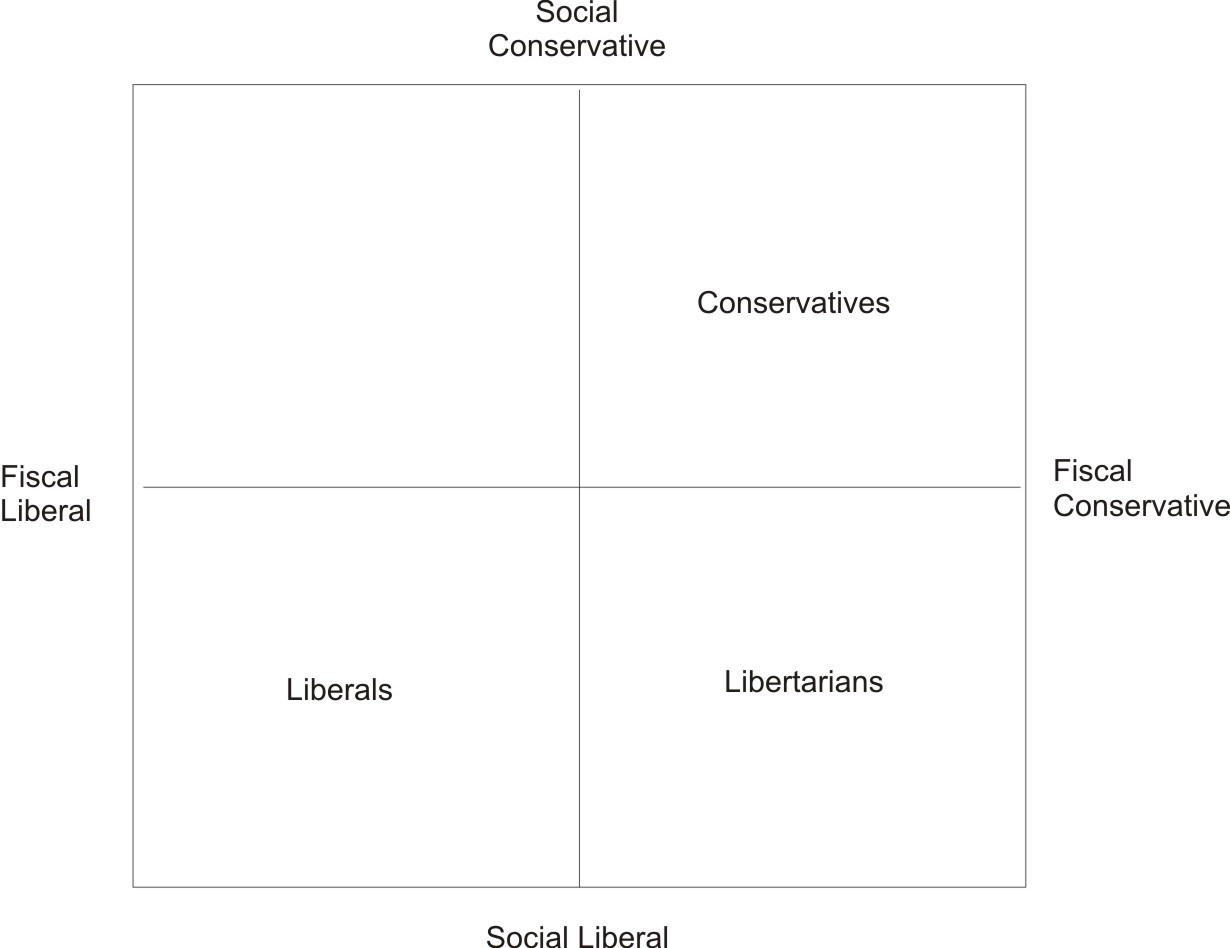

But this chart still just shows two-dimensions.  To capture the traditionalism dimension as well as the authoritarianism/libertarianism dimension, and the left-right economic dimension, you would have to have a three-dimensional chart: a cube. But that would be hard to visualize.  Besides, what if we added another dimension? Nobody can visualize a four-dimensional chart. It's better to visualize more than two dimensions as shown below. Now we've upgraded the stupid little "tone" knob. Now we have an equalizer. We're Hi-Fi.


Now we can start to do justice to the range of views people really have, especially those who can't be accurately placed on the simple left-right spectrum (and most people can't). Here we can see how a moderate liberal who values civil liberties (me), compares to an authoritarian communist like Stalin. Regardless of what some people think about liberals, we're not that close:


Of course, there are many more factors that determine a person's politics than these three, and other ways of dividing them. The psychologist Jonathan Haidt has parsed political attitudes in a different way, along five different dimensions that affect peoples' political leanings: "1) harm/care, 2) fairness/reciprocity (including issues of rights), 3) ingroup/loyalty, 4) authority/respect, and 5) purity/sanctity".  (I described these in detail in this post). The "authority" dimension is similar to the one in the Political Compass chart above, but views on economic policy and traditionalism are divided into multiple other dimensions. In the chart below, we can see how American liberals, conservatives, libertarians, and Tea Party supporters differ on these dimensions.


Now, in all the charts above, we're talking about people's attitudes in general. We're not talking about particular political issues. But the traditional left-right spectrum fails us when it comes to those, too, as in the case of my gun-toting-but-otherwise-liberal friend. So why not divide those up too, and tackle each one on its own terms, rather than lumping them together? After all, why should your stance on abortion have anything to do with your stance on gun control, or gay marriage? Maybe a common set of values informs your opinions on all three, as it does for many in the religious right, or maybe it doesn't, as with libertarians.  It makes more sense to picture each issue as a separate knob on a political equalizer, like the one above, except with particular issues instead of general attitudes.


That's a whole lot more sophisticated than the left-right spectrum, to say nothing of the liberal vs. conservative dichotomy. But it's still a little too simple. Because if we focus in on most issues, we'll find that they are really a set of issues. For example, the range of possible views about abortion can't be captured by setting a knob somewhere along the pro-choice/pro-life axis. What about someone who is pro-choice up until the fetus can experience pain, and pro-life afterward? We would have to put such a person somewhere in the middle of the spectrum, but it would be more accurate to just have a more complex scale--an abortion attitudes equalizer, perhaps. Or maybe it would be better to forget the graphics at this point and describe in words the nuances of that person's belief.

That's the thing: all labels and graphics are limited. They're just maps, not the territory itself. The more detailed the map, the better (within reason), but no map captures the full complexity of the political landscape. Some may say we should keep things simple, and that all these nuances about politics are too complicated. Well, reality is complicated, and our political views need to be complicated enough to navigate that reality honestly, if not always effectively. People forget that. They forget that reality is more complicated than our simple dichotomies, and even our sophisticated charts. When they mistake the maps for reality, they start thinking reality is as simple as their maps are. It isn't.

Political labels tend to short-circuit independent thought. As soon as we label ourselves as liberals, conservatives, libertarians, or whatever, we're in danger of thinking: I'm a ___________ therefore I think ___________. That's backwards. What we should do is decide independently what we think about each issue, based on a careful consideration of the facts and arguments, instead of how we were raised, how we label ourselves, or what our friends think.

Of course, that's hard to do. We don't have time to research all the issues, we have different psychological predispositions and biases, and it's easier to follow a crowd and buy an ideology as a package deal. In fact, it's hard not to, because political groups have more to do with tribal loyalty than critical thinking. Whether you're part of the liberal tribe or the conservative tribe, tribalism is a powerful force. Break ranks on a hot issue, and you're sure to be criticized, and possibly ostracized.

These are all real issues, but none of them have much to do with truth. In fact, they all get in the way of it. Tribalism, in particular, is a lousy way of figuring out what's true and right. People should think very carefully before calling people traitors because they've drawn a different conclusion than the rest of their peers. No worthwhile ideology should seek to protect itself from dissent. If what we're seeking is truth, not ideology, the idea of betraying an ideology is nonsensical. Our loyalty should lie with truth, not ideology. If the ideology is wrong, we shouldn't believe it anymore. If we think something because someone tells us to, or because that's what people with our label are supposed to think, we're not actually thinking. We have to learn to think first, and apply labels second. Or maybe we should just ditch the labels altogether, so we'll remember to think for ourselves.

Saturday, December 29, 2012

Beyond Belief

I haven't posted in a while, partly because of holiday travels, but mostly because I've been composing my thoughts in private messages to some of my friends. After I wrote a post about the idea of God, I got into discussions with some more conservative Christian friends, and very interesting discussions they've been. One thing that came up is the importance of beliefs versus actions. For many Protestants, it is belief alone, not actions, that determines whether you go to heaven or hell. If you believe that Jesus is the son of God, and that he died to atone for your sins, that is what gets you into heaven. Being a good person is important, but it's not what decides your fate in the afterlife. The official doctrine of many Protestant denominations is that if you live a good life, devoting yourself to helping others, but don't accept Jesus as your savior, you'll go to hell.

Clearly, whether this is true or not is a matter of no small importance (for the record, I don't think it is, for all kinds of reasons). So I was debating my evangelical friends about it. Why, I asked them, does God care so much about what we believe? Why doesn't he care as much about what we actually do? It was an interesting debate, but I don't want to discuss Christian theology in this post. What I want to talk about here is the relative importance of belief versus actions, not in a religious sense (because I'm not religious), but in the context of a secular ethics that doesn't require belief in the supernatural. Contrary to what the Mike Huckabees and James Dobsons of the world will have you believe, religion has no monopoly on morality.

My debates with my Christian friends put the issue of belief/action into sharper focus for me. I was asking them why belief itself is so important, but then I thought: Wait a minute...I think belief is important too! I'm always railing against the kind of relativism that says reality is socially constructed, and therefore truth is relative to one's culture. Sure, some things (money, national borders, etc.) are socially constructed, but not everything is. I think there is an objective reality, that it was around for billions of years before humans were, and that it's important for our beliefs to match that reality as well as possible.

But why is it important? Why do beliefs matter? Well, I've always maintained that they matter because we act on them. It matters whether you believe, for example, that animals are automatons who can't feel pain and suffering. If you believe that, you'll be more likely to treat them as such--leaving them out in the rain on a cold night, for example. If that belief is factually wrong (and I'm pretty sure it is) then your actions will be ethically wrong, because you'll be causing them suffering.

But while debating with my friends, I realized that if beliefs matter because of how people act on them, then actions, not beliefs, are doing the moral heavy lifting. Action is where belief runs into morality, isn't it? How can a belief you don't act on have a moral consequence? These questions bring me up short, because my knee-jerk attitude is that correct belief is important whether it has ethical consequences or not. I want to understand this world I find myself in as best I can, and to the extent that my beliefs are wrong, I have failed. If I went along with a some of my more New Agey friends and believed in astrology, and if that belief never had any ethical impact (which is unlikely) does that mean it's OK to believe in astrology? Lord, no! Because it's not true, doggonit! Why go through life thinking something that's not true, if you can help it?

Still, I have to admit that it's much more important to be right about beliefs with moral implications than those without them. If I told you that a hummingbird is a direct descendant of a dinosaur--that it IS a dinosaur, in strict phylogenetic terms--I'd be telling you the mainstream scientific theory of the origin of birds. Most dinosaurs went extinct, and the rest evolved into birds. But if you look at that hummingbird and say, "Dinosaurs?! No way!", it won't be the end of the world. You'll probably be an equally good person whether you believe it or not.

All these questions reminded me of the viral image at the top of this post, which I had seen making the rounds on the internet a few weeks before my debate over heaven, hell, and belief. I decided to get more of my friends' input on the whole question, so I posted the picture on Facebook, and asked: True or false? When I first saw the picture, I thought, "Wow, that's a good point". I even felt a little chastened, because I certainly do more thinking than charitable volunteering.  But not everyone agreed with me. One friend said "False", maintaining that "if you do the right thing for the wrong reason you're not being a good person". Another friend agreed, saying that if a racist and a non-racist act exactly the same way, the non-racist is still a better person. These seem like valid points to me, and I might not have thought about them otherwise (which is one reason I think dialogue is so important, but that's another blog post).

Another friend said the statement was false because your beliefs are what determine your actions. That's a good point, too, but it's not always true. For example, I truly think I would be a better person if I didn't eat meat, especially from animals raised inhumanely, like the chickens I see crammed into cages on trucks going down the interstate. But I love meat, and I hate to cook, and I go on eating meat at fast food joints. Yes, I set up an automatic withdrawal to donate a few bucks to the Humane Society every month, in the hope that they will work to make factory farming more humane, but I still eat those chicken sandwiches, with a small side order of guilt every time.  I'm NOT acting on my beliefs, and I don't act on them several times a week. So, it's true that beliefs are important, but it's not true that right beliefs necessarily lead to right actions, and that's really the whole point of the words on the chalkboard.

Another friend made an excellent point, which is worth quoting in full:  "I think perhaps it's worded wrongly to make what I assume is the intended point. It should say something like "beliefs themselves aren't enough to make you a better person. Behavior / action is required as well." I.E. you can believe we need to care for the homeless all day long, but actually have to donate to / volunteer at the soup kitchen for those beliefs to matter." This highlights a big problem I've noticed in our soundbite age: catchy slogans aren't subtle enough to capture the complexity of reality, but subtle, thoughtful statements, alas, rarely go viral (this might explain a whole lot about our world, and I'm not just talking about the internet era). Of course, her main point is that the words on the chalkboard present a false dichotomy. Both belief and action are important, especially since beliefs determine actions so much of the time. But the point of the picture is still a good one, and I'm glad it made the rounds. You can believe all day that poverty is awful, but that won't do anything unless you actually get up and try to do something to help.

So, am I actually volunteering at a soup kitchen? No. I'm sitting here writing, trying to work out what I believe, instead of getting off my butt and making myself useful. I tend to indulge my cerebral self, spending a lot of my free time reading and writing about life's questions, big and little. And to some extent, I think that's justified, because beliefs and ideas really do matter. People act on their ideas, so it's important to spend some time thinking about what you're going to act on.  Since that's true, thinking and writing can be valuable actions, because it can influence not only how you act, but how others act. Ideas aren't just powerful because they can influence one person's actions. Ideas spread and multiply, so one person can have an idea that can spread throughout the world, and cause a lot of good or a lot of bad. I've never had one of those ideas myself, but you never know, and besides, if I can gain a few insights this way, and perhaps encourage other people to have even better insights, or question potentially harmful beliefs, that's worthwhile. (That's an important point for this discussion, actually. When it comes to beliefs that cause harmful actions, the actions are the most important thing, but in a negative way. It would be better not to act on those beliefs).

Still, I probably spend too much time thinking, and not enough time doing. I've always liked the Buddhist parable where people are asking the Buddha metaphysical questions of the sort he had little time for: "Is the world infinite or finite? Does the soul exist after death?" He told them they were like a man who has been shot with a poisoned arrow. Before letting anyone remove it, the man wants to know who shot him, what family his assailant came from, what kind of poison is on the arrow, and so on. By the time he answers all these questions, he'll be dead. What he needs to do right now is forget about them, and yank that arrow out.

It's a good point. Endless speculation about unanswerable questions won't make the world a better place. Of course, some unanswerable questions become answerable if you keep at them long enough. "What is the sun made of?" was once unanswerable, but eventually it was answered (by science, it should be pointed out, not philosophy or religion). Still, speculation can only get you so far. Belief can only get you so far, even if you know for a fact that you're right. What makes ideas and beliefs matter most is the impact they actually have. I don't always remember this, but I should try to. And then I should try to do something about it.

Saturday, December 8, 2012

Long Ago and Far Away: How Galaxies Disprove Creationism


Several times lately, I've found myself explaining to my conservative Christian friends what I find so objectionable about creationism. My biggest beef is with young earth creationism (YEC), which holds that the earth was created just as described in Genesis, in six days, just a few thousand years ago. In my explanations, I've been saying the same thing over and over again: YEC is objectionable because someone who is willing to believe it isn't just rejecting evolutionary biology and parts of geology--they're basically rejecting all of science.  All the major branches of science--astronomy and physics, chemistry, practically all of biology, and even anthropology and archaeology--are unanimous in telling us the earth is incredibly ancient.  I keep saying this, but I just realized I haven't really explained what I mean, by giving examples from sciences other than biology. In this post, I'd like to do just that, giving an example from astronomy.  The most distant galaxies tell us that the universe is far older, and far grander, than the authors of Genesis could have imagined.

If you get out a star map and consult the skies, you'll see that the Little Dipper is embraced by a dragon; a serpentine constellation known as Draco. Draco, however, has been conquered by another constellation: Hercules. In old maps of the constellations, Hercules is kneeling, club aloft, with his foot on Draco's head. Of course, this is all mythology--the constellations are just random arrangements of unrelated stars, but it's interesting mythology. Even if Hercules and Draco exist only in our minds, the stars are real. If you had super-vision, you could walk out at night and look right through Hercules, past the stars to the distant galaxies beyond them. If you did that, you would see what the Hubble Space Telescope can see: the great cluster of galaxies in the image above.

Take a second, if you will, to look at this image and reflect on just what you are seeing.  Those aren't stars; those are entire galaxies. When you look up at a starry sky, almost everything you see with your naked eyes is inside our own galaxy. In this image, we're looking beyond our galaxy, at a whole cluster of other galaxies. Each one has billions of stars; more stars than you could count in a lifetime. The objects in this photograph are almost too big to fathom, but here's my favorite way of trying: a beam of light goes fast enough go from New York to San Francisco nearly 100 times in a second, yet it would take that beam of light over 100,000 years to cross a galaxy the size of the Milky Way. If the galaxies in the image are like our own, many of the stars inside each one are circled by planets. There might even be life on those planets, perhaps on millions of those planets. There could be ancient, advanced civilizations, as sophisticated compared to us as we are compared to flock of geese. That's speculation, but not wild speculation. When you're looking at an image containing trillions of suns, a whole lot of things seem possible.

The big, fuzzy football at the center of the image is Hercules A, which is a giant elliptical galaxy. Like many giant ellipticals, it's grown fat by devouring other galaxies. In fact, if you look closely, you can see a smaller galaxy that may be in the process of being engulfed. Giant elliptical galaxies are huge even by galactic standards. They may contain over a trillion stars; a trillion thermonuclear fireballs, each one far larger than the earth. In fact, the data indicate that Hercules A is about a thousand times as massive as the Milky Way.

That's all very impressive, but there are countless galaxies as big as Hercules A across the universe. Why focus on this one? Because Hercules A has a secret.To see it, you have to look at it in a different light.  Literally--you have switch from visible light to another part of the spectrum, and form an image out of radio waves. In the picture below, a radio image from the Very Large Array, a set of 27 enormous radio dishes in the New Mexico desert, has been superimposed on the visible light image above.


Here we can see that Hercules A is dwarfed by twin jets of subatomic particles emerging from its center.  Each of these jets is about 1.5 million light years long, which means it would take a beam of light (and I mentioned how fast those go) about 3 million years to get from one end to the other. What's causing the jets is a humongous black hole at the center of the galaxy, weighing about 2.5 billion times as much as our sun. Matter is swirling into the black hole and disappearing, forming a giant disk of luminous plasma at the center of the galaxy, perpendicular to the jets. All this creates powerful magnetic fields, which funnel electrons and other particles out from the center of the disc in both directions.  Moving at nearly the speed of light, these particles form the jets in the image, which give off radiation in the form of radio waves.

That's all pretty astounding, even before we consider how truly weird a black hole is. We're talking about something so massive that nothing can escape, not even light.  Space and time themselves stretch and warp at the edge of the black hole until the known laws of physics break down. Physicists admit they have no idea what happens inside a black hole, and won't know until some new Einstein can unify quantum mechanics and general relativity. Respectable scientists at places like Oxford and Yale talk about how black holes might give birth to new universes, or to wormholes that link far-flung regions of our own universe by taking a sort of shortcut through space-time. So, all in all, Hercules A is rather impressive.  But I started this post talking about creationism, particular young earth creationism. What does a distant galaxy have to do with that?

First, it shows how little the writers of Genesis understood about the universe. They were smart people, but they were writing long before modern science. The earth was flat for all they knew, and the stars and planets were absolute mysteries to them. They couldn't have known that the stars shone with their own light, while the moon and planets reflected the light of the sun. They would have had no clear concept of a galaxy, even though the great band of the Milky Way would have been visible in those ancient desert skies. It would be millennia before Immanuel Kant speculated that the cloudy blobs we see in our telescopes weren't just nebula in our own Milky Way, but "island universes" in their own right. And this wasn't confirmed until the early 20th century, when Edwin Hubble realized just how far away galaxies are, and that they are all rushing apart as the universe expands. Modern astronomy has shown us a universe far grander than the writers of Genesis could have imagined. They were doing their best, but they were living in the early Iron Age. If they had had telescopes, they might have written a different story.

The other thing distant galaxies tell us about young earth creationism is that it can't possibly be true, at least if it suggests that the universe was created at the same time as the earth. If Adam was created right after the whole universe was created, he would have looked up on the first night to see a sky devoid of stars, because the starlight wouldn't have arrived yet. The closest star visible from the northern hemisphere is Sirius A, the Dog Star. It's 8.6 light years away, which means that light takes 8.6 years to get from there to here. That means Adam would have had to wait over eight years to see the first star appear in the sky. Over the years, more and more stars would have appeared, but there are some stars so far away that Adam never would have seen them, even if he lived 930 years, as Genesis 5:5 tells us he did. In fact, some of the stars in the night sky are so far away that, if the Earth really were ten thousand some-odd years old, we still wouldn't see them. Their light wouldn't have reached us yet because they are over 10,000 lights years away. And that's just what's inside our own galaxy.

If the Earth were that young, we wouldn't be able to see a single galaxy beyond the Milky Way. Our closest galactic neighbor is the dim, recently-discovered Sagittarius Dwarf galaxy, which practically hugs the Milky Way at a distance of 70,000 light years.  Hercules A, by contrast, is 2.1 billion light years away. Since we can see it in our telescopes, that means the universe is old enough for its light to have reached us--and that would have taken around 2 billion years (the expansion of the universe complicates the calculations for faraway galaxies, so that's a ballpark figure). Hercules A, then, tells us that the universe is at least 2 billion years old.

If we're seeing two-billion year old light when we look at Hercules A, that means we aren't seeing it as it is today. We're seeing it as it was two billion years ago. The farther back astronomers look, the farther they are looking back in time. If paleontology worked that way, studying evolution would be a cinch. A paleontologist could look off in the distance with a telescope and see bison in the foreground, mammoths in the middle distance, and dinosaurs in the background. That might solve the creation-evolution debate.

As remote as it is, Hercules A is far from the most distant galaxy known. The farthest known galaxy right now is 13.3 billion light years away. If we can see it, the universe must be over 13 billion years old. In fact, other measurements indicate that the universe is 13.7 billion years old. That means that we can see galaxies as they were just a few hundred million years after the universe began.

None of this makes any sense if you believe the universe only thousands of years old. If you do, the only way you can explain the fact that we can see distant galaxies is by saying God created the universe so it just looks like light from those galaxies had been traveling for billions of years. Some creationists really say this, talking about how the universe was created "with the appearance of age". In other words, according to this theory, if the Hubble Space Telescope had been present on the first day of creation, and had picked up a beam of light forming an image of Hercules A, the beam of light would have had to be created at the same time as Hercules A itself, but over two billion light years away from it. If that's true, then that seems like a pretty elaborate deception on God's part.

But it gets worse. If the light carries an image of Hercules A as it would have looked 2 billion years ago, but the universe is far less than 2 billion years old, then the light beam is showing us something that never happened.  That would mean the pictures above are pictures of something that never was.  They are just illusions created by God.  Now, some hard-core young earth creationists would actually accept this explanation. Some people really believe that things like fossils were put in place to test our faith in the Bible. These people would rather believe in a God who intentionally deceives us than believe that the universe really is far older than humankind.

Needless to say, I can't accept that. Genesis is an ancient, mythological text. Perhaps there is wisdom to be found in it, but not by taking it as literally true, because it isn't. The universe is far more awe-inspiring than the authors of Genesis could have known, and we are lucky to be living in a time when science is making its wonders known to us.  If there's a God, he's a lot greater and more sophisticated than the God suggested by Genesis, who creates a puny little universe through crude hocus-pocus. Those who believe in God and also accept the lessons of science, with its ancient galaxies and evolving earth, have concluded that science has made God greater than the ancients could have known.  This isn't a God who creates some spring chicken of a planet and fashions people out of clay. This is a God who flings galaxies. As for me, I don't claim to know if there's a God or not, but if there is, he would have to be a magnificent cosmic architect compatible with real science, not the deceptive tinkerer imagined by creationists.

__________________________________________________________________

A Radio-Optical View of the Galaxy Hercules A

Visiting the Very Large Array

Star Tales: Hercules

I got the argument that young earth creationism would require God to create images of things that never existed from the book Finding Darwin's God, by Kenneth Miller, a respected biologist who is also a devout Christian.