Showing posts with label United States. Show all posts

Sunday, January 6, 2013

Left, Right, and Other Directions: Getting Over One-Dimensional Politics

During the French Revolution, members of the National Assembly began to sort themselves according to their politics. Traditionalist supporters of king and church sat on the right, while those favoring radical ideas like establishing a more secular republic sat on the left. The terms "left" and "right" stuck, and today we talk about a political spectrum spanning the range from communism on the far left to fascism on the far right.


It's a strange idea, really. For one thing, the directions are completely arbitrary. If the members of the National Assembly had sat in a different arrangement, today we might be talking about far-left Republicans and far-right Democrats. Also, the idea of a political spectrum implies that political views are simple enough to plot along a single dimension, and that everyone's political views can be accurately plotted on that line. They can't. I have a friend who is an absolute fire-breathing liberal...except that he's against gun control. Where do you put him on that line? You can't. Like most people, he's simply not one-dimensional.

The political spectrum is a crude instrument. It reminds me of one of those cheap radios which, instead of having separate knobs for bass and treble, simply has one labeled "tone". Still, these days in the United States, even the idea of a political spectrum seems to be too subtle for some people. We've slipped into either/or, black/white thinking. The center has not held. It's given way to a sort of no man's land where people fear to venture, for fear of being called a traitor.  The other day, I picked up a recent issue of The American Spectator. The first article in the magazine referred to Chris Christie, the Republican governor of New Jersey, as "Judas" for saying nice things about how the Obama administration handled Hurricane Sandy. I've heard other moderate Republicans, like the Davids--Frum and Brookes--called traitors. Many on the right these days collapse everyone left of center into a big heap; lumping liberals, socialists, and even communists all together.

But liberals do the same things. Some of them see Obama as a traitor for some of his centrist--even right-leaning--policies (keeping Guantanamo Bay Prison open, for example). Some of them also consider it taboo to say nice things about the other side. I've had some very liberal friends get mad at me for saying far-right politicians might be decent people in some ways.

These days, in other words, we see politics less as a spectrum and more like this:


It's either/or. You're either a liberal or a conservative, in this view, and there's no room in the middle. It's like the tone dial on that cheap radio has gotten even less useful. It's become a switch, which forces you to choose bass or treble. If you try to step into the center, you'll find you have nowhere to stand. Move that way from either direction, and someone behind you will lump you with the other side and call you a traitor.

Maybe we should put the center back, and give it some respect. People tend to think of moderates as wishy-washy fencesitters. But that's not necessarily true. Some people carefully considere all the evidence for and against various issues, and the conclusions they draw happen to place them in the center. Those who think moderates must be too noncommittal to take a stand are subscribing to the simple-minded view that there are only two possible sides. Besides, moderation has a long and respectable history. As smart people like Aristotle and Buddha have reminded us, wisdom very often requires finding a balance between opposite extremes. Principled, thoughtful moderates should hold their head high, and tell both sides they have a right to be there.

But the center is a precarious place to be. It's less well-defined than left and right. Those in the center don't have a clearly defined group they can identify with, so there's a temptation to join one side or the other. Ideologues on both sides are suspicious of them. So, moderates can stay in the center and be glared at from both sides, or they can join a side and have clearly-defined allies. Contrary to the charges of wishy-washiness, it can be much more comfortable to take a side. In Elmer Kelton's Texas Ranger Trilogy, the sheriff trying to keep the peace says, "I'm just tryin' to stay in the middle ground". His wise preacher friend replies, "That can be the most dangerous place of all. People shoot at you from both sides."

With the human tendencies toward binary thinking and tribalism, being a moderate is like standing on a knife-edged ridge. If you're not careful, you'll roll down one side or the other, into one of the more well-defined groups. Maybe you'll have fiercer enemies then, but you'll also have fiercer friends. You'll have a well-defined identity, and a social support system. This may sound a bit like a slippery slope argument, but in this case the slope really is slippery. There's a lot of pressure to join one side or the other.


So, maybe instead of thinking in the binary bins of left and right, we should put the center back in its rightful, respectable place, as a well-defined group. Maybe this country needs a Moderate Party, so that the moderates have a place to call home.

Of course, this just divides the binary vision of politics into three categories--Left, Right, and Moderate--and that's still much too simplistic. It still lumps everyone on the right, and everyone on the left, together--as though there were no diversity on either side. But there's a great deal of diversity. Ronald Reagan was no Mussolini, and Barack Obama is no Lenin. People on both sides think there's a slippery slope from the moderate regions of the other side to the extreme regions. Some on the right, for example, think that if we institute universal healthcare, before long we'll be living in collective farms or gulags.

But I admit that as a moderate liberal, I've had the same thoughts in the opposite direction. George W. Bush really did remind me of Mussolini when he talked about the country "speaking with one voice". The little black bumper stickers that said "W. The President" scared me. I thought they smacked of fascism; of authoritarian ultra-nationalism and blind allegiance to a charismatic leader. I kept thinking of the quote attributed to Sinclair Lewis, "When fascism comes to America, it will be wrapped in the flag and carrying a cross". Still, I doubt that W was really an American fascist. I think he would have stopped at some point and said, "That's far enough". But I wish he had said so more often.

It seems that some people on the left see the political spectrum like this:


While some on the right see it like this:


The right sees the left on a slippery slope that could tumble into communism, and the left sees the right on a slippery slope to fascism. But neither slope is as slippery as the other side thinks. I tend to be fairly liberal, and many of my friends are more liberal than me. But none of them are communists. I've only ever met two communists, and that was in Canada.  Liberal or not, I didn't identify with them. In fact, I thought both of them were loud-mouthed fools. I don't think I know anybody who is even a socialist, if by "socialist" you mean someone who thinks "the state should own most means of production". Most liberals are just that: liberals. They're not socialists, much less communists. And most conservatives are conservatives. They're not closet fascists or Nazis.

There's a lot of diversity along the political spectrum, and in the United States today, it may be that the only slippery slope is away from the center. But even if we think in terms of a spectrum instead of a binary opposition, we're still just thinking in terms of one dimension, and that's just not enough. I started to realize this in college. That was the heyday of campus political correctness, in the early '90's. While I'm glad we no longer refer to humankind as "Man", sometimes this movement went too far. Liberalism was starting to turn away from freedom of speech more than I liked, and I started thinking of the political spectrum as a sort of circle, where the farther you got toward either extreme, the less you were interested in preserving freedom.

But I was still thinking in one-dimensional terms, as though there were some law of nature that says politics must be plotted on a single line, however slope-y or circular. It makes more sense to just add another dimension, as the people at PoliticalCompass.org have done. They have added a dimension of authoritarianism versus libertarianism.


This gives us a two-dimensional chart. The left-right axis charts economic attitudes: if you're for extensive government control of the economy, you're on the far left, and if you're all about free markets, then you're on the far right. But your place on that axis might have nothing to do with your views on personal freedom. Someone on the left or right economically could still be a strong believer in civil liberties. On this chart, Stalin would be in the upper left, while Hitler or Mussolini would be just right of center at the top. Someone like George W. Bush would be somewhere in the upper right, but (hopefully) not that close to Mussolini. American libertarians, who are usually all for personal freedom about things like sex, drugs, and religion, but also pro-free market, would be in the lower right hand corner. The traditional left-right spectrum can't do justice to libertarianism at all.

But this chart has its drawbacks, too. Some authoritarians, for example, are all for tradition, while others are for revolution. The religious right in the US is authoritarian to varying degrees about traditional values, but Stalin and Mao were authoritarian in a completely non-traditionalist way--they wanted to overturn the traditional order. The chart above can't capture that difference well, because it defines left and right in purely economic terms. Some people handle this by taking a slightly different perspective, and separating social views from fiscal views, as in the chart below. You hear libertarians in the United States saying they are fiscal conservatives and social liberals. A libertarian might be farther right than Ronald Reagan on economic issues, but couldn't care less about people's religion, sex life, or drug use.
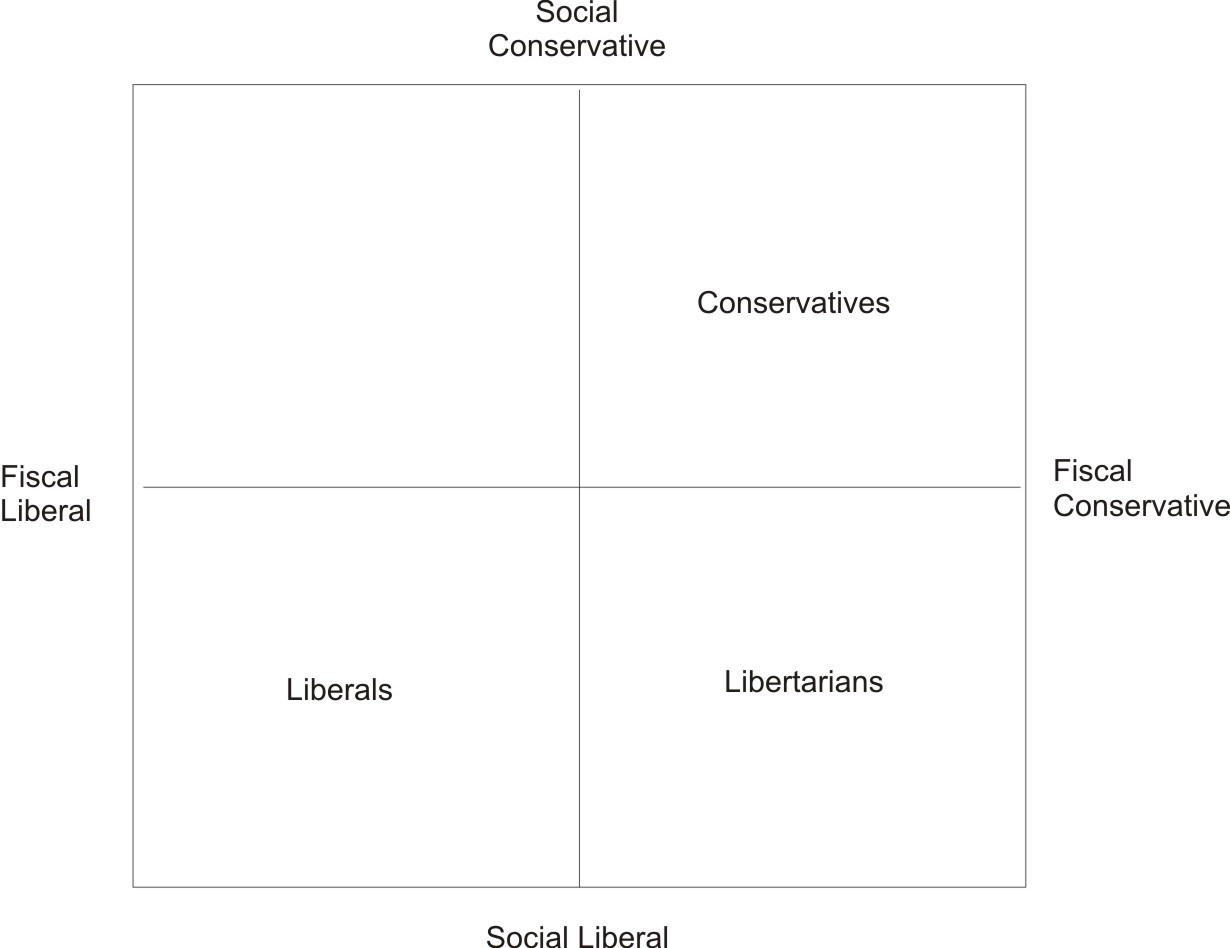

But this chart still just shows two-dimensions.  To capture the traditionalism dimension as well as the authoritarianism/libertarianism dimension, and the left-right economic dimension, you would have to have a three-dimensional chart: a cube. But that would be hard to visualize.  Besides, what if we added another dimension? Nobody can visualize a four-dimensional chart. It's better to visualize more than two dimensions as shown below. Now we've upgraded the stupid little "tone" knob. Now we have an equalizer. We're Hi-Fi.


Now we can start to do justice to the range of views people really have, especially those who can't be accurately placed on the simple left-right spectrum (and most people can't). Here we can see how a moderate liberal who values civil liberties (me), compares to an authoritarian communist like Stalin. Regardless of what some people think about liberals, we're not that close:


Of course, there are many more factors that determine a person's politics than these three, and other ways of dividing them. The psychologist Jonathan Haidt has parsed political attitudes in a different way, along five different dimensions that affect peoples' political leanings: "1) harm/care, 2) fairness/reciprocity (including issues of rights), 3) ingroup/loyalty, 4) authority/respect, and 5) purity/sanctity".  (I described these in detail in this post). The "authority" dimension is similar to the one in the Political Compass chart above, but views on economic policy and traditionalism are divided into multiple other dimensions. In the chart below, we can see how American liberals, conservatives, libertarians, and Tea Party supporters differ on these dimensions.


Now, in all the charts above, we're talking about people's attitudes in general. We're not talking about particular political issues. But the traditional left-right spectrum fails us when it comes to those, too, as in the case of my gun-toting-but-otherwise-liberal friend. So why not divide those up too, and tackle each one on its own terms, rather than lumping them together? After all, why should your stance on abortion have anything to do with your stance on gun control, or gay marriage? Maybe a common set of values informs your opinions on all three, as it does for many in the religious right, or maybe it doesn't, as with libertarians.  It makes more sense to picture each issue as a separate knob on a political equalizer, like the one above, except with particular issues instead of general attitudes.


That's a whole lot more sophisticated than the left-right spectrum, to say nothing of the liberal vs. conservative dichotomy. But it's still a little too simple. Because if we focus in on most issues, we'll find that they are really a set of issues. For example, the range of possible views about abortion can't be captured by setting a knob somewhere along the pro-choice/pro-life axis. What about someone who is pro-choice up until the fetus can experience pain, and pro-life afterward? We would have to put such a person somewhere in the middle of the spectrum, but it would be more accurate to just have a more complex scale--an abortion attitudes equalizer, perhaps. Or maybe it would be better to forget the graphics at this point and describe in words the nuances of that person's belief.

That's the thing: all labels and graphics are limited. They're just maps, not the territory itself. The more detailed the map, the better (within reason), but no map captures the full complexity of the political landscape. Some may say we should keep things simple, and that all these nuances about politics are too complicated. Well, reality is complicated, and our political views need to be complicated enough to navigate that reality honestly, if not always effectively. People forget that. They forget that reality is more complicated than our simple dichotomies, and even our sophisticated charts. When they mistake the maps for reality, they start thinking reality is as simple as their maps are. It isn't.

Political labels tend to short-circuit independent thought. As soon as we label ourselves as liberals, conservatives, libertarians, or whatever, we're in danger of thinking: I'm a ___________ therefore I think ___________. That's backwards. What we should do is decide independently what we think about each issue, based on a careful consideration of the facts and arguments, instead of how we were raised, how we label ourselves, or what our friends think.

Of course, that's hard to do. We don't have time to research all the issues, we have different psychological predispositions and biases, and it's easier to follow a crowd and buy an ideology as a package deal. In fact, it's hard not to, because political groups have more to do with tribal loyalty than critical thinking. Whether you're part of the liberal tribe or the conservative tribe, tribalism is a powerful force. Break ranks on a hot issue, and you're sure to be criticized, and possibly ostracized.

These are all real issues, but none of them have much to do with truth. In fact, they all get in the way of it. Tribalism, in particular, is a lousy way of figuring out what's true and right. People should think very carefully before calling people traitors because they've drawn a different conclusion than the rest of their peers. No worthwhile ideology should seek to protect itself from dissent. If what we're seeking is truth, not ideology, the idea of betraying an ideology is nonsensical. Our loyalty should lie with truth, not ideology. If the ideology is wrong, we shouldn't believe it anymore. If we think something because someone tells us to, or because that's what people with our label are supposed to think, we're not actually thinking. We have to learn to think first, and apply labels second. Or maybe we should just ditch the labels altogether, so we'll remember to think for ourselves.

Saturday, December 8, 2012

Why I'm Being a Pain About Science and Religion

Lately I've been getting a little more vocal about my religious beliefs, or lack thereof.  Since I have a lot of friends who are religious, most of them Christian, I want to explain why I've gotten so vocal. I'm not doing it to bait Christians, or to try to make them abandon their faith. I don't get any particular kick out of trying to shock people or being a rebel. I don't have the slightest wish to see Christianity, or any other religion, outlawed, though you sometimes hear people saying that's what people like me want. What I do want is to feel like I don't have to cover up what I believe. I grew up in rural Arkansas, where most people are devout and conservative Christians. If you tell people there that you aren't a Christian, they will be shocked and worried for you, whether you want them to be or not.  Because of that, I used to keep my beliefs quiet. I still do, around some people, just too avoid a conversation I don't want to have (or quite possibly in some areas, a butt-whupping I don't want to have). But at the age of forty, I feel like I shouldn't be afraid to say what I think, at least to people whose opinions I respect.

Besides, I'm worried about my country. The last few decades have seen a huge growth of fundamentalism in Christianity, Judaism, and Islam, and fundamentalist Christians have gained enormous political power in this country.  They're using that power to try to break down the wall between church and state that was one of the founding principles of the United States.  Several of the most important founders, especially Jefferson, Madison, Franklin, and Thomas Paine, were free-thinking sorts who weren't Christians in any traditional sense. Jefferson even edited the Gospels, literally cutting out all the supposed sayings of Jesus that he didn't think Jesus would have said. You often hear people say those guys were Deists, but Thomas Paine is the only one who was a true Deist throughout his adult life. Still, they sure as heck weren't Southern Baptists.

Since so many of the founders were free-thinkers, I think it's vital, nearly 250 years later, for modern free-thinkers to stand up and say, "Here I am, and I'm an American, too". It's also vital that we push back against attacks on the separation of church and state. We non-religious types aren't alone in that, because many Christians and other religious people support that separation, too. They remember that the whole idea of separating church and state originally came from religious people who didn't want to be persecuted by a state-sponsored majority religion. People who want to weave religion and government back together always seem to assume it will be their version of religion that prevails. That's a dangerous assumption. If I were Catholic, Jewish, or belonged to any other minority religion (instead of a non-religious minority), I would think very carefully whether I wanted to mingle religion and government. 

I also want to question fundamentalism itself, particularly the kind of biblical literalism that suggests that the world was literally created in six days, and that Noah actually got two of each animal on earth into an ark (did he go to Australia and get kangaroos?) Those things just can't be true, and I want to convince people not to believe them any more. But that doesn't mean I want to convince anyone to abandon Christianity itself. I don't. In fact, if someone told me they had stopped being a Christian (or believer in any other religion) because of something I had said, I would probably feel a little queasy, and ask them if they were sure that's what they wanted to do. Setting aside a lifelong faith isn't something to be taken lightly, and I don't want to be the sole reason anybody does it. After all, it's not like I know everything.

What I do know is that the world wasn't created in six days, and it's not just a few thousand years old. Noah didn't get all those animals in the ark. He just didn't. Dinosaurs didn't, as some creationists say, walk the earth when people did. So, I would like to convince my more literal-minded Christian friends to abandon creationism and absolute biblical literalism (they want to convince me to be a Christian, so fair is fair). You can be a good Christian and still believe that humans, and every other living thing, evolved from simpler life forms. You can be a good Christian and believe that Noah and the flood are legends (derived from earlier Sumerian legends, in fact) and never really happened. I know a lot of Christians who see the world this way.

Some of my Christian friends talk to me about this stuff, and ask, "Why is this such a big deal to you? Does it really matter how old some politician, for example, thinks the earth is?" Yes, it does, for several reasons. First, someone who believes that Genesis is literally true is more likely to think men were created prior to women, and that women were a sort of afterthought created to give Adam some company. Biblical literalists are more likely to believe the earth was created for humans, and that we were created in the image of God. That makes them more likely to think other living things are simply here for us to use as we see fit. Worse than that, someone who literally believes in Genesis is more likely to think God created the earth with a preconceived plan, and therefore wouldn't let anything like global warming come along and ruin it.  I've heard influential politicians make this very argument. It's dangerous to think God will protect us from screwing up the whole earth through global warming, nuclear war, or some other disaster, because we really could do it.  I saw the following quote a while back (by William Gore, the 5th Baron Harlech, of all people): "It would indeed be the ultimate tragedy if the history of the human race proved to be nothing more noble than the story of an ape playing with a box of matches on a petrol dump." Pessimistic, yes, but the quote haunts me. What if the universe is littered with the bones of creatures that got just intelligent enough to blow themselves up? Survival of the fittest, indeed.

Another problem with biblical literalism is that if you believe the earth is just a few thousand years old, as young earth creationists do, mainstream science says you're making a mistake of enormous magnitude. If the earth is really 4.5 billion years old, as the overwhelming majority of scientists think it is, that means it's 450,000 times as old as you think it is. Not only that, but if you're willing to believe that the Bible is literally true when it says the whole universe was created all at once in a few days, that means you're willing to deny all the sciences, not just evolutionary biology. Nearly every branch of science--astronomy, physics, chemistry, geology, biology, anthropology and archaeology--all of them point unanimously to the fact that the earth and universe are incredibly ancient, and that even latecomers like humans have been around a few million years. I tell people this all the time, but I've realized lately I don't offer them examples. So it's time I offered a little evidence. In my next post, I want to talk about faraway galaxies, and what they have to tell us.

Friday, February 10, 2012

All-Natural Goodness: Are there Natural Laws of Morality?

As anyone who reads this blog will have noticed, I've been obsessed lately with philosophical ideas about ethics.  In particular, I've been fascinated by this question: Why should we be ethical?  In other words, where do ethics come from?  What is it about the world we live in that dictates that we should do some things, and should not do others?  Before you cross to the other side of the street next time you see me, let me clarify what I mean. I certainly think we should be ethical.  I haven't suddenly decided there's no reason not knock over the next bank I see.  It's just that I've discovered that if you start thinking about the foundations of ethics, you run into some fascinating conundrums.

In my last post, I talked about problems with the assumption that what is ethical is simply whatever God commands.  What if God commanded you to take a rifle and shoot everyone over six feet tall?  Would that be good, because God said so?  If you say "No, God would never command that, because that is bad", then you have admitted that there must be a standard of good and bad independent of God.  This doesn't mean you can't still believe in God, and believe in God's commands, but it does mean you have to accept that, if what God commands is what is good, it must be good for some reason other than "Because I said so". 


SOCRATES, PLATO, AND "THE GOOD"

If moral principles like goodness and justice don't come from God's will, where do they come from?  One of the most common answers is that they're an intrinsic part of nature or reality.  Socrates and Plato both believed that they were objective realities...higher realities, in fact, than the world we live in.  Plato developed the idea further than Socrates, arguing that when we recognize an instance of goodness, we are sensing a general, universal "Good"; an eternal form, of which particular instances are pale reflections.  The idea of such Platonic forms is an interesting one.  Personally, I think it's more plausible that these "forms" are creations of our minds, which can take several particular instances of a category, and then construct an image of a "perfect" or "general" version of that category.  If a child who has never seen an equilateral triangle sees many triangles with unequal sides, it's quite possible that she could imagine a "perfect" equilateral triangle.  

Perhaps the idea of Good and Justice are the same kinds of mental constructions.  But maybe they really are "out there" somewhere.  Some modern mathematicians actually are Platonists, who believe that when they find new mathematical proofs, they're actually discovering something that already had an independent reality.  Maybe they're right--maybe logic and number are intrinsic, fundamental features of the universe.  But it seems to me that it's far less parsimonious to suggest that Justice is an intrinsic feature of the universe.  I can imagine that laws of geometry or logic might be real and independent of our minds, but something as complex and apparently subjective as "Good" seems like a less likely candidate.  It requires more extensive assumptions about the nature of reality.

Both Plato and Socrates seemed to think that reason is what allows us to understand the eternal forms of Good and Justice.  They also thought that if we understand goodness and justice, we will automatically be good and just.  If that seems far fetched to you, join the club.  There's a pretty big gulf between knowing what's right and actually doing it.  I'm sitting here wearing a t-shirt that may very well have been made in some awful sweatshop.  I know I should have sprung for a more expensive "fair trade" t-shirt.  But I didn't.  Not from lack of knowledge, but from a not-especially-admirable lack of will.

ARISTOTLE'S PURPOSEFUL UNIVERSE

Aristotle was a more down-to-earth thinker than his predecessors, and didn't believe in Platonic forms, or that simply knowing what is good will insure that someone actually is good.  Aristotle believed that all living things have a telos; a natural state or purpose to which they aspire.  "The Good" for Aristotle is for something to realize its purpose to the highest degree possible.  If an anteater is a creature whose essence is to eat ants, then what is good for an anteater is to excel at its ant-eating lifestyle.  Aristotle saw reason as the distinguishing feature of human beings (maybe he was a little starry-eyed), and he argued that what is good or virtuous for humans is to excel at reasoning.  However, he argued that people have use their reason to decide what habits are good, and then work at cultivating those habits.  In other words, he was an advocate of virtue ethics, the stance that ethics consists in cultivating virtues, or habits of goodness.  What's important for us, however, is that Aristotle didn't see "The Good" as a universal Platonic form.  He believed what was good for any particular thing depended on what sort of thing it was, and what its ultimate purpose was. 

THE EVOLVING IDEA OF NATURAL LAW

After Aristotle, the idea that there are laws of morality in nature (or human nature) that transcend laws of particular governments, and can be discovered by reason, came to be known as "natural law".  I've been reading about natural law off and on all week, and it's a complicated subject, because there have been many versions of natural law thinking.  Here's my understanding (take it with a grain of salt).  Aristotle is often said to be the founder of natural law theory, though it seems to me that Plato and Socrates were advocates of "higher laws", and could also be said to believe in natural law.  In any case, various forms of natural law theory have been promoted by a long line of thinkers.  The Roman Stoics believed in cosmic lawfulness, and were among the first to maintain that humans were created equal (an idea that would have seemed laughable to the Greek philosophers).  The Roman statesman Cicero promoted the idea that unjust laws are out of tune with higher, natural law, and thus shouldn't be accepted as laws at all.  

St. Paul seems to have believed that all people, even non-Christians, have a sense of universal law.  St. Augustine also believed in natural law, but he believed that the world had fallen from its state of perfect natural law after the fall of Adam and Eve.  For Augustine, humankind, and the world we live in, are now characterized more by sin and evil than by goodness and justice.  St. Thomas Aquinas was much less pessimistic about human nature, and about nature itself.  In his Aquinas' day, Aristotle's writings had recently been rediscovered in Europe.  Amazed by Aristotle's insights, Aquinas tried to harmonize the old heathen's philosophy with Christianity.  Aquinas saw natural law as a subset of God's eternal law.  He believed that the highest good was to know God, but he also believed, like Aristotle, that everything in nature has a purpose, and that whatever furthers that purpose is good.  He believed that certain virtues could be discovered by reasoning about natural law, while others could only be known through faith.  Like many others before and after him, Aquinas equated what he saw as natural for humans with what is moral.  For example, he condemned homosexuality on the grounds that the natural purpose of sex and marriage is procreation.  Since homosexuals could not procreate, their behavior was seen as unnatural, and therefore, wrong.  More on this line of thinking later.

NATURAL LAW AND NATURAL RIGHTS

After the Renaissance, when people became more individualistic and less focused on religion, natural law theories took on a different tone, which focused more on the natural rights of individuals.  Hobbes, who famously believed that human life in the state of nature was "solitary, poor, nasty, brutish, and short", nevertheless believed in natural law.  For Hobbes, however, natural law was a very different thing than for Aristotle or Aquinas. Hobbes thought natural law corresponded to the laws rational people would naturally come to accept as the right way to live, in order to transcend the state of nature (the time when people were irrational and unconstrained in their violence).  To this end, he was the first to suggest the idea of a social contract which people could enter into to insure their basic rights and safety.  Hobbes thought that rational people would see the necessity for a sovereign, or king, who could enforce the laws that keep people from being too nasty to each other.  Hobbes was rejecting the traditional idea of the divine right of kings (a revolutionary idea, whether he meant it to be or not) and suggesting that a king's power is justified by the need for a social contract, and a sovereign strong enough to maintain order.  

Hugo Grotius, a Dutch contemporary of Hobbes, made influential arguments based on natural law regarding just war theory and the law of the seas.  Although he was a very religious man, Grotius argued that natural law would exist even if "we should assume the impossible, that there is no God or that he does not care for human affairs".  This was also quite radical, of course, because it claimed that God wasn't essential to natural and moral law.  John Locke took Hobbes' idea of a social contract, and turned it around, claiming that a king or government's power is only legitimate if it protects the rights of its citizens to "life, liberty, and property".  If it fails, the people have a right to revolt and create a new government. 

Of course, colonial Americans did just that.  In the Declaration of Independence, Thomas Jefferson summed up the natural law philosophy of his day, closely echoing Locke.  Because this is one of the most influential documents in history, it's worth quoting at length:
When in the Course of human events it becomes necessary for one people to dissolve the political bands which have connected them with another and to assume among the powers of the earth, the separate and equal station to which the Laws of Nature and of Nature's God entitle them, a decent respect to the opinions of mankind requires that they should declare the causes which impel them to the separation.
We hold these truths to be self-evident, that all men are created equal, that they are endowed by their Creator with certain unalienable Rights, that among these are Life, Liberty and the pursuit of Happiness. That to secure these rights, Governments are instituted among Men, deriving their just powers from the consent of the governed, That whenever any Form of Government becomes destructive of these ends, it is the Right of the People to alter or to abolish it, and to institute new Government, laying its foundation on such principles and organizing its powers in such form, as to them shall seem most likely to effect their Safety and Happiness.
Here we see, in the founding document of what is now the world's most powerful country, all the threads of the natural law theory of the time.  These ideas, as far as I'm concerned, represented a huge leap forward in justice and liberty.  Even though some groups, such as women and slaves, were not immediately credited with that equality, or extended those rights, they have gained them over time, partly because of the power of the ideas of natural rights and natural law.  It was a tremendous accomplishment.

QUESTIONING NATURAL LAW

The Declaration of Independence was written well over 200 years ago, so it's no surprise that science and philosophy have moved beyond the ideas it expresses.  As brilliant as Jefferson and some of the other founders of the United States were, they were people of their time.  They would have had no reason to question the Aristotelian idea that there is a natural purpose to everything in nature.  They also had no reason to question the idea that human reason is a sure route to transcendent truth, and that there is such a thing as a "self-evident" idea.  Many, following Locke, would have believed that the human mind is a "blank slate".  Almost all of them believed in a God that had created the natural order of things, though some, like Jefferson, were Deists who believed God set the universe in motion and then mostly left it alone.  

In the century after the Declaration, other ideas came along that challenged some of its assumptions.  Jeremy Bentham, the founder of Utilitarianism, suggested that the ethics of an action should be judged based on its consequences--specifically, whether or not it increases the amount of happiness in the world--instead of whether it is dictated by natural law.  Bentham was scornful of the idea of natural rights, calling it "nonsense on stilts".

Even more importantly, Darwin realized that the amazing diversity of life had nothing to do with an intrinsic order in which every living thing had its purpose and its role to play.  He saw that nature is not eternal and unchanging, and that living things, including humans, could have evolved through the blind process of evolution by natural selection.  In Darwin's view of nature, species do not exist to serve some Aristotelian purpose.  A species exists because it evolved to fit into its ecological niche.  While a species may come to play a role in nature, because it inter-adapts with other species that may come to rely on it, this is accidental.  Even if cows can't live without grass, grass didn't evolve to feed cows.

In the 1800's, then, it came to seem less likely that natural order was due to a divine architect who had written natural law and natural rights into the blueprints, to be discovered by the pure power of human reason.  Humans could now be seen as another on of the animals, albeit a very brainy one.  The human mind could be seen as a product of the blind process of evolution.  This means there is no guarantee that reason is a window into eternal truth, or even that we are especially reasonable creatures.  Smart, yes, but not necessarily wired to recognize eternal truths.  Besides, science--which was based on observation instead of pure reason--was chalking up one triumph after another.  This started to make traditional philosophy look plodding and outmoded. 

And then there were people like Jeremy Bentham, who raised a very good question: does it really make sense to say that morality is based on some transcendental natural law?  Aristotle and Aquinas' view of the natural purpose of humans and other animals--one major source of natural law thinking--had been dealt a serious blow.  Some were even questioning whether God was necessary at all.  If humans and other creatures were not put on Earth for a certain purpose, what sense did it make to talk about ethical laws having a reality unto themselves?  Are moral laws somehow written across the sky?  Or should we just follow Bentham, and say that ethics are simply a way of maximizing pleasure and minimizing pain? 

PRELIMINARY CONCLUSIONS

Here's how I see it, for what it's worth.  The modern scientific view suggests that the universe, and life on earth, has evolved in ways that can be explained entirely in terms of blind physical laws. While I'm not going to take the leap of faith required to state flatly that there is no God, or that there is no conceivable purpose to the universe, it seems to me quite plausible that there is no intrinsic purpose.  I've read about science and nature for years, and never seen something that seems like a clear-cut purpose to me.  If nature wasn't created with a purpose in mind, and to the extent that its order can be explained by physical laws instead of divine design, it doesn't make sense to assume that there are natural laws of morality written into the universe.  Goodness, truth, and justice are great things, but not because they are fundamental to nature in the way that light and matter are.

The only version of natural law that makes sense to me is similar to that of Hobbes, who saw natural law as reflecting the conclusions rational people will naturally come to when deciding how to organize their society....so that it's tolerable to live in it.  This view doesn't see natural law as something fundamental in nature, but as something that arises out of nature, when people with the ability to reason come along.  Some people would say this doesn't seem much like a natural law.  Maybe not, but it doesn't really concern me whether or not ethical laws are fundamental to reality.  If ethical laws are something we invent because it makes sense to do so, well, good for us. Or, perhaps what is really a fundamental natural law is not the presence of positive natural law, but the absence of something:  the absence of any good reason to think my interests are any more valuable than yours are, and that I shouldn't treat you ethically.  

Actually, I think science and nature, as well as pure reason, can tell us a lot about ethics, even if there really isn't a natural law of morality.  We are a part of nature, and if we don't understand it, we're likely to make mistakes with ethical consequences.  Also, our ethical sense is based on emotional impulses, such as empathy, fairness, guilt, and even disgust, that are a product of our evolution as social animals.  So, we need to understand the intersection between nature and ethics.  However, we have to be very careful when looking to nature to decide what is right and good.  There is a lot of good in nature, but not everything in nature is necessarily good.  Skeptical?  Stay tuned...