Showing posts with label government. Show all posts

Friday, October 4, 2013

Memo: Editing Jesus

Rick Bachabee
President

Cross and Sword Coalition of America

Wrapped in the flag and carrying a cross”

Brothers and Sisters,

The Religious Right has had some real success in the the last few years. The Tea Party movement has finally brought Christ's message of small government and low taxes to state governments and the halls of Congress. I'm happy to say we're as powerful as we've ever been. 

But, brothers and sisters, I'm troubled by the things I hear from our enemies. No, I'm not talking about the Muslims or the gays. I'm talking about those who call themselves Christians, but turn their backs on far-right politics. Some of these pretenders, and their secular allies, have taken to calling us the H word. You guessed it...hypocrites. They go on and on about how Jesus loved the poor and healed the sick, and they say if we really wanted a Christian government, then we would want that government to help them. They even say that's what our Savior himself would have done! Where do they get this stuff?

Even worse, these pretenders in Christ have taken to quoting scripture, using the Bible--OUR Bible--against us. They're getting that hypocrite stuff right out of the Gospels, using Jesus' own words to call us "false prophets" and "wolves in sheep's clothing." The nerve of some people! 

Just the other day I saw people using these verses from Matthew against us:
 42 For I was hungry and you gave me nothing to eat, I was thirsty and you gave me nothing to drink, 43 I was a stranger and you did not invite me in, I needed clothes and you did not clothe me, I was sick and in prison and you did not look after me.’ 44 “They also will answer, ‘Lord, when did we see you hungry or thirsty or a stranger or needing clothes or sick or in prison, and did not help you?’ 45 “He will reply, ‘Truly I tell you, whatever you did not do for one of the least of these, you did not do for me.’
Now, we all know Jesus wasn't really taking up for a bunch of ragged takers looking for handouts. It might seem like he was, but that's a misinterpretation. Some parts of the Bible should be taken literally and some shouldn't. The parts about God creating the Earth in six days, the snake that talked, Noah living 950 years; those are literally true. That's just common sense. 
But some passages require a more subtle interpretation. 

Those words from Matthew are those of Christ himself, and we all know he spoke in parables. He didn't literally mean to give food to hungry people, or invite dirty, half-dressed strangers into our houses and places of worship. I mean really, is that how our Savior would have acted? It's a parable, like the mustard seed or the camel passing through the eye of the needle.

You knew that one would come up didn't you? They love to use that part of Matthew against us. You know the one, where the rich man asks Jesus what he should do to get into heaven:
21 Jesus answered, “If you want to be perfect, go, sell your possessions and give to the poor, and you will have treasure in heaven. Then come, follow me.” 22 When the young man heard this, he went away sad, because he had great wealth. 23 Then Jesus said to his disciples, “Truly I tell you, it is hard for someone who is rich to enter the kingdom of heaven. 24 Again I tell you, it is easier for a camel to go through the eye of a needle than for someone who is rich to enter the kingdom of God.”
Those verses always have been troublesome, haven't they? Personally, I don't think Christ could have really said them. Sell your possessions and give to the poor? That's practically communist! It doesn't fit in with our gospel of prosperity at all. And that stuff about how hard it is for the rich to get into heaven...what is that about? That young man was a job creator!

No, Jesus just wouldn't have said that, and he certainly wouldn't have said it twice for emphasis, like that passage implies. Of all his lessons, why would he pick that one to emphasize? Why not the evils of homosexuality, the dangers of evolution, or the importance of keeping "Under God" in the Pledge of Allegiance? It just doesn't make sense.

Brothers and sisters, there's only one thing to do: We've got to change those verses. That's the only way to keep people from reading them in inconvenient ways. The ones I've been quoting make Jesus out to be some kind of bleeding heart who loved everybody unconditionally. And we can't have that. 

So let me show you what I have in mind. Take the first pairs of “Blessings and Woes” in Luke. We could change those in several different ways to reflect their one true meaning, but here are my suggestions:
Blessed are you who are poor, for yours is the kingdom of God rich, for you are the job creators, and yours is the kingdom of God.
Blessed are you who hunger now,  for you will be satisfied are well fed now, for that proves you are hard workers. Or at least rich, and therefore blessed (see above).
But woe to you who are rich, for you have already received your comfort poor, for you have already received your handouts. 
Woe to you who are well fed now, for you will go hungry who hunger now, for we cut your food stamps.
See how easy that is? And speaking of blessings, we can leave "blessed are the peacemakers" alone. That was clearly a prophecy foretelling the coming of the Colt Peacemaker; the gun that would win the west. When Jesus comes back, I'm betting that's the sidearm he'll carry. Try taking that one away, gun-grabbers!

I could do this all day, but I think you get the idea. Give it a try! Grab the Sermon on the Mount and a red pen and get busy. It's time we bring the Bible in line with our actual practices. If we start talking like we've been walking, how can anyone accuse us of being hyp...the H word?

Now, I know some of you will have qualms at first. But what are our other options? As long as we say we want a Christian government, people are going to say, "Well, then, why don't you want it to help the sick and poor?" We could cave in and let them keep church and state separate, but then we'd be taking mandatory prayer out of the schools, teaching unexpurgated science, letting homosexuals marry, and opening liquor stores on Sunday. And we can't have all that. 

The other option is to keep calling for a Christian government, and start following all that stuff about helping the poor, healing the sick, loving our enemies, being merciful, blah blah blah...  I don't know about you, but that one doesn't sound good to me either. 

No, if people keep using the H word on us, there's only one way to have our cake and eat it too, and that's editing the Holy Scriptures themselves. I know it may seem shocking. But if you think about it, we on the far right have been editing Jesus for a long time with our words and deeds. All I'm doing is pointing it out; spelling out what's usually unspoken. What should be shocking is for Christians to act in direct opposition to Jesus' words.

And that's why we have to change those words! Sure, people will give us a hard time at first, even that foolish majority of Christians who think Jesus meant what he said about this stuff. But if we keep repeating the new versions, they'll eventually forget the old ones. Americans have a short attention span these days. Besides, if we finally take over this country, then we'll be the ones calling the shots about how the Bible is read.

Yours in Christ,

Rick Bachabee

Saturday, July 27, 2013

School-Sponsored Prayer: What's the Harm?

Last night I didn't feel like reading, especially not the geeky books I usually read. But there wasn't much else to do. So I watched a geeky video. It was an old Bill Moyers interview, from 1987, called God and the Constitution. Moyers talks to Dr. Martin Marty, a Christian and an expert on the religious views of the founders, and Leonard Levy, a Jewish constitutional scholar who edited The Encyclopedia of the American Constitution. All three men are stunningly smart, and I urge everyone to watch it (you can stream it for 3 bucks on Amazon.com, or watch it for free if you have a library card and your local library has Access Video on Demand).

The part that struck me the most was Dr. Levy talking about school-sponsored prayer. (Not voluntary student prayer, which is protected by the First Amendent. I want to make clear nobody is saying kids shouldn't be allowed to pray on their own at school.) Levy offers one of the most powerful and personal arguments I've ever heard for keeping official prayers out of schools. It's more impressive if you watch the video, but here's the transcript:
Moyers: What about school prayer?  
Levy: I think that the state should not promote or sponsor religion.  
Moyers: But there are prayers and "prayers." You grew up in De Kalb, Illinois, right?  
Levy: I did.  
Moyers: 20 Years ago in De Kalb the court said the cookie prayer was unconstitutional.  
Levy: I forgot that it came out of De Kalb!  
Moyers: "We thank you for the flowers so sweet, we thank you for the food we eat, we thank you for the birds that sing we thank you, God, for everything." The court declared it unconstitutional even though the teacher took out the word "God".  
Levy: She did, but the court didn't quite declare it unconstitutional. When the Supreme Court won't agree to review a case, they allow the lower court decision to stand. If that's how you construe it--which is reasonable--yes, the court, in effect, upheld that.  
Moyers: Now, do you think the founding fathers would have thought that little verse an establishment of religion?  
Levy: I think not, but... to begin with, that's a prayer being said in the public school. The founding fathers had no position with respect to this because public schools as we know them did not exist. Prayers do not belong in public schools even though they are sterilized, as in the cookie prayer which is non-denominational, and doesn't even refer to God. I agree with you that religious liberty would not be imperiled if children said the cookie prayer in the public schools.  
Moyers: The teacher said she was only trying to instill a sense of wonder in the children--to make them appreciative of the world around them and of the divine being that made that world. She wasn't trying to persuade or to indoctrinate them.  
Levy: These cases are very complex. That's why the court divides so closely and so frequently. When you say that that teacher wanted to inspire children with a sense of wonderment and you referred to her talking about a supreme being, that is a religious statement. You and I may believe it but there are people who don't believe it. 
Moyers: You think the First Amendment protects atheists?  
Levy: Of course it does! The First Amendment protects religion and non-religion. There are people who are not theists who are in our public schools by the thousands. There are people who are not Christians or Jews or Muslims and they ought not be exposed to that cookie prayer which alludes to a divine being who allegedly created the world. You think so and I think so, but there are people who don't think so and they shouldn't be made to feel like outsiders, as if they don't belong, as if this is not their country. It's their country as much as it is ours. 
Moyers: If I remember correctly you refused to take part in prayers in De Kalb, Illinois, when you were a boy there--1935, 1936. What happened when you said "I can't participate in that prayer."  
Levy: What happened? Well, I was ostracized. No, more than that--I was persecuted. They beat me up regularly as I went home from school. Gangs of kids would jump out and beat the hell out of me and call me a "Jew bastard" and "Christ killer." I loved to play softball, and I was kept off the team. "No kikes on our team," was the motto which had, by the way, some sponsorship from the faculty. When religion is introduced directly into the public schools there is a price that may very well be paid by people who are different. There have often been times when persecution was visited upon children who wouldn't participate in the public school rituals of religion.
Powerful stuff. Of course, the thirties were a very different time, and I don't think that kind of thing would happen to Jewish kids these days. At least not as commonly and openly. But kids can be very cruel when they decide to single out another kid, mobbing them like a bunch of crows. And I can certainly imagine them abusing a Hindu or Sikh kid, or especially a Muslim or atheist kid, for declining to participate in Christian prayers. Even if they didn't (and most often they wouldn't), that kid would be put in a very, very uncomfortable situation. Now, some people will say that this doesn't apply in overwhelmingly Christian areas. But it does. I'm from a small, white, Protestant town smack in the middle of the Bible Belt, but there were a handful of Hindu and Muslim kids even there, and probably more than a handful of non-religious kids. The Hindu and Muslim kids were younger than me, and I don't know if they were ever harassed because of their religion. If so, I would think it was probably minor. But I might be wrong, and I'm pretty sure they would have had a tougher time if they had been put in the position of deciding whether or not to say prayers along with the Christian kids. That could have opened up a can of worms. So why open it? Leaving official prayer and other religious observances out of school keeps the problem from ever arising, or at least from arising because of school policy. And besides, Dr. Levy is right. It's their country, too.

Sunday, January 6, 2013

Left, Right, and Other Directions: Getting Over One-Dimensional Politics

During the French Revolution, members of the National Assembly began to sort themselves according to their politics. Traditionalist supporters of king and church sat on the right, while those favoring radical ideas like establishing a more secular republic sat on the left. The terms "left" and "right" stuck, and today we talk about a political spectrum spanning the range from communism on the far left to fascism on the far right.


It's a strange idea, really. For one thing, the directions are completely arbitrary. If the members of the National Assembly had sat in a different arrangement, today we might be talking about far-left Republicans and far-right Democrats. Also, the idea of a political spectrum implies that political views are simple enough to plot along a single dimension, and that everyone's political views can be accurately plotted on that line. They can't. I have a friend who is an absolute fire-breathing liberal...except that he's against gun control. Where do you put him on that line? You can't. Like most people, he's simply not one-dimensional.

The political spectrum is a crude instrument. It reminds me of one of those cheap radios which, instead of having separate knobs for bass and treble, simply has one labeled "tone". Still, these days in the United States, even the idea of a political spectrum seems to be too subtle for some people. We've slipped into either/or, black/white thinking. The center has not held. It's given way to a sort of no man's land where people fear to venture, for fear of being called a traitor.  The other day, I picked up a recent issue of The American Spectator. The first article in the magazine referred to Chris Christie, the Republican governor of New Jersey, as "Judas" for saying nice things about how the Obama administration handled Hurricane Sandy. I've heard other moderate Republicans, like the Davids--Frum and Brookes--called traitors. Many on the right these days collapse everyone left of center into a big heap; lumping liberals, socialists, and even communists all together.

But liberals do the same things. Some of them see Obama as a traitor for some of his centrist--even right-leaning--policies (keeping Guantanamo Bay Prison open, for example). Some of them also consider it taboo to say nice things about the other side. I've had some very liberal friends get mad at me for saying far-right politicians might be decent people in some ways.

These days, in other words, we see politics less as a spectrum and more like this:


It's either/or. You're either a liberal or a conservative, in this view, and there's no room in the middle. It's like the tone dial on that cheap radio has gotten even less useful. It's become a switch, which forces you to choose bass or treble. If you try to step into the center, you'll find you have nowhere to stand. Move that way from either direction, and someone behind you will lump you with the other side and call you a traitor.

Maybe we should put the center back, and give it some respect. People tend to think of moderates as wishy-washy fencesitters. But that's not necessarily true. Some people carefully considere all the evidence for and against various issues, and the conclusions they draw happen to place them in the center. Those who think moderates must be too noncommittal to take a stand are subscribing to the simple-minded view that there are only two possible sides. Besides, moderation has a long and respectable history. As smart people like Aristotle and Buddha have reminded us, wisdom very often requires finding a balance between opposite extremes. Principled, thoughtful moderates should hold their head high, and tell both sides they have a right to be there.

But the center is a precarious place to be. It's less well-defined than left and right. Those in the center don't have a clearly defined group they can identify with, so there's a temptation to join one side or the other. Ideologues on both sides are suspicious of them. So, moderates can stay in the center and be glared at from both sides, or they can join a side and have clearly-defined allies. Contrary to the charges of wishy-washiness, it can be much more comfortable to take a side. In Elmer Kelton's Texas Ranger Trilogy, the sheriff trying to keep the peace says, "I'm just tryin' to stay in the middle ground". His wise preacher friend replies, "That can be the most dangerous place of all. People shoot at you from both sides."

With the human tendencies toward binary thinking and tribalism, being a moderate is like standing on a knife-edged ridge. If you're not careful, you'll roll down one side or the other, into one of the more well-defined groups. Maybe you'll have fiercer enemies then, but you'll also have fiercer friends. You'll have a well-defined identity, and a social support system. This may sound a bit like a slippery slope argument, but in this case the slope really is slippery. There's a lot of pressure to join one side or the other.


So, maybe instead of thinking in the binary bins of left and right, we should put the center back in its rightful, respectable place, as a well-defined group. Maybe this country needs a Moderate Party, so that the moderates have a place to call home.

Of course, this just divides the binary vision of politics into three categories--Left, Right, and Moderate--and that's still much too simplistic. It still lumps everyone on the right, and everyone on the left, together--as though there were no diversity on either side. But there's a great deal of diversity. Ronald Reagan was no Mussolini, and Barack Obama is no Lenin. People on both sides think there's a slippery slope from the moderate regions of the other side to the extreme regions. Some on the right, for example, think that if we institute universal healthcare, before long we'll be living in collective farms or gulags.

But I admit that as a moderate liberal, I've had the same thoughts in the opposite direction. George W. Bush really did remind me of Mussolini when he talked about the country "speaking with one voice". The little black bumper stickers that said "W. The President" scared me. I thought they smacked of fascism; of authoritarian ultra-nationalism and blind allegiance to a charismatic leader. I kept thinking of the quote attributed to Sinclair Lewis, "When fascism comes to America, it will be wrapped in the flag and carrying a cross". Still, I doubt that W was really an American fascist. I think he would have stopped at some point and said, "That's far enough". But I wish he had said so more often.

It seems that some people on the left see the political spectrum like this:


While some on the right see it like this:


The right sees the left on a slippery slope that could tumble into communism, and the left sees the right on a slippery slope to fascism. But neither slope is as slippery as the other side thinks. I tend to be fairly liberal, and many of my friends are more liberal than me. But none of them are communists. I've only ever met two communists, and that was in Canada.  Liberal or not, I didn't identify with them. In fact, I thought both of them were loud-mouthed fools. I don't think I know anybody who is even a socialist, if by "socialist" you mean someone who thinks "the state should own most means of production". Most liberals are just that: liberals. They're not socialists, much less communists. And most conservatives are conservatives. They're not closet fascists or Nazis.

There's a lot of diversity along the political spectrum, and in the United States today, it may be that the only slippery slope is away from the center. But even if we think in terms of a spectrum instead of a binary opposition, we're still just thinking in terms of one dimension, and that's just not enough. I started to realize this in college. That was the heyday of campus political correctness, in the early '90's. While I'm glad we no longer refer to humankind as "Man", sometimes this movement went too far. Liberalism was starting to turn away from freedom of speech more than I liked, and I started thinking of the political spectrum as a sort of circle, where the farther you got toward either extreme, the less you were interested in preserving freedom.

But I was still thinking in one-dimensional terms, as though there were some law of nature that says politics must be plotted on a single line, however slope-y or circular. It makes more sense to just add another dimension, as the people at PoliticalCompass.org have done. They have added a dimension of authoritarianism versus libertarianism.


This gives us a two-dimensional chart. The left-right axis charts economic attitudes: if you're for extensive government control of the economy, you're on the far left, and if you're all about free markets, then you're on the far right. But your place on that axis might have nothing to do with your views on personal freedom. Someone on the left or right economically could still be a strong believer in civil liberties. On this chart, Stalin would be in the upper left, while Hitler or Mussolini would be just right of center at the top. Someone like George W. Bush would be somewhere in the upper right, but (hopefully) not that close to Mussolini. American libertarians, who are usually all for personal freedom about things like sex, drugs, and religion, but also pro-free market, would be in the lower right hand corner. The traditional left-right spectrum can't do justice to libertarianism at all.

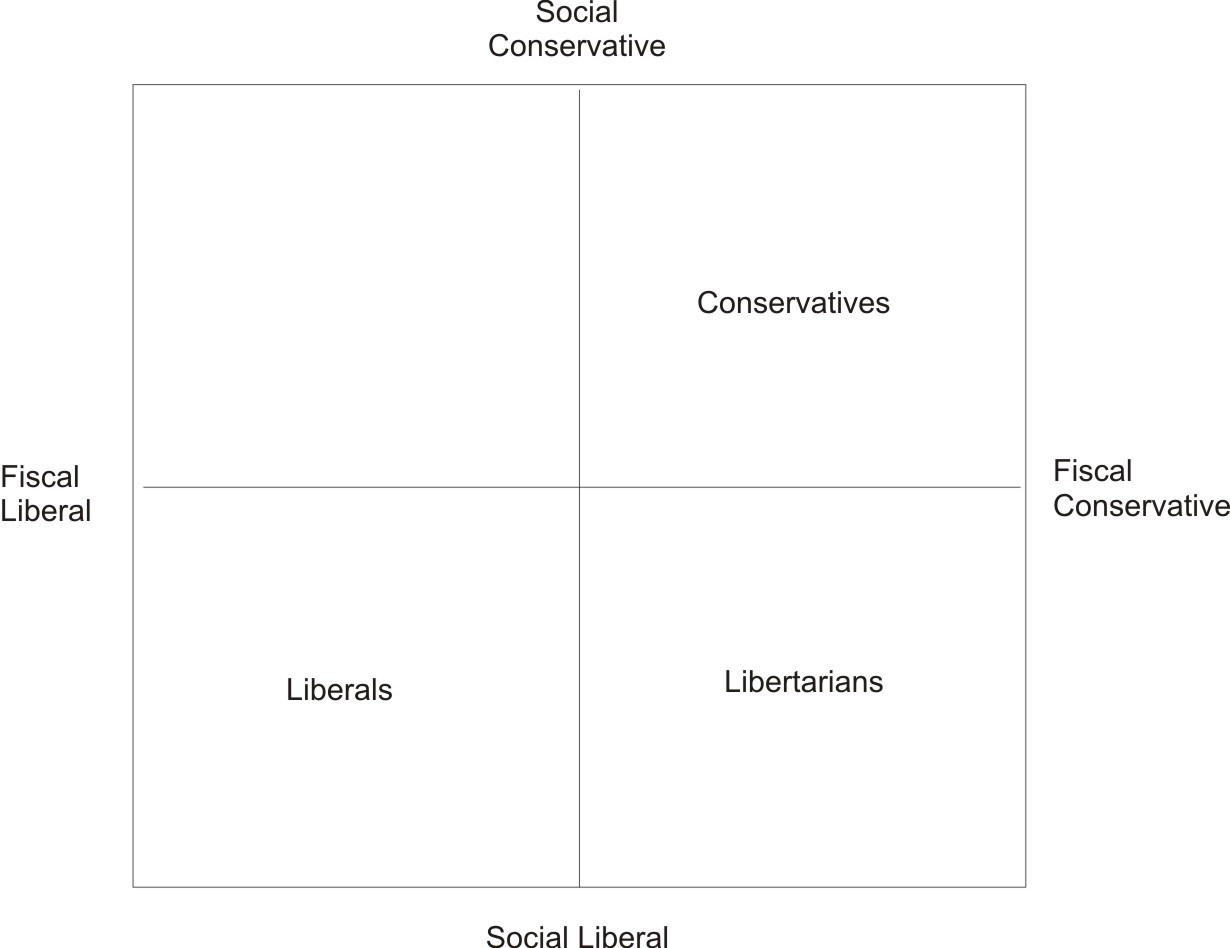
But this chart has its drawbacks, too. Some authoritarians, for example, are all for tradition, while others are for revolution. The religious right in the US is authoritarian to varying degrees about traditional values, but Stalin and Mao were authoritarian in a completely non-traditionalist way--they wanted to overturn the traditional order. The chart above can't capture that difference well, because it defines left and right in purely economic terms. Some people handle this by taking a slightly different perspective, and separating social views from fiscal views, as in the chart below. You hear libertarians in the United States saying they are fiscal conservatives and social liberals. A libertarian might be farther right than Ronald Reagan on economic issues, but couldn't care less about people's religion, sex life, or drug use.


But this chart still just shows two-dimensions.  To capture the traditionalism dimension as well as the authoritarianism/libertarianism dimension, and the left-right economic dimension, you would have to have a three-dimensional chart: a cube. But that would be hard to visualize.  Besides, what if we added another dimension? Nobody can visualize a four-dimensional chart. It's better to visualize more than two dimensions as shown below. Now we've upgraded the stupid little "tone" knob. Now we have an equalizer. We're Hi-Fi.


Now we can start to do justice to the range of views people really have, especially those who can't be accurately placed on the simple left-right spectrum (and most people can't). Here we can see how a moderate liberal who values civil liberties (me), compares to an authoritarian communist like Stalin. Regardless of what some people think about liberals, we're not that close:


Of course, there are many more factors that determine a person's politics than these three, and other ways of dividing them. The psychologist Jonathan Haidt has parsed political attitudes in a different way, along five different dimensions that affect peoples' political leanings: "1) harm/care, 2) fairness/reciprocity (including issues of rights), 3) ingroup/loyalty, 4) authority/respect, and 5) purity/sanctity".  (I described these in detail in this post). The "authority" dimension is similar to the one in the Political Compass chart above, but views on economic policy and traditionalism are divided into multiple other dimensions. In the chart below, we can see how American liberals, conservatives, libertarians, and Tea Party supporters differ on these dimensions.


Now, in all the charts above, we're talking about people's attitudes in general. We're not talking about particular political issues. But the traditional left-right spectrum fails us when it comes to those, too, as in the case of my gun-toting-but-otherwise-liberal friend. So why not divide those up too, and tackle each one on its own terms, rather than lumping them together? After all, why should your stance on abortion have anything to do with your stance on gun control, or gay marriage? Maybe a common set of values informs your opinions on all three, as it does for many in the religious right, or maybe it doesn't, as with libertarians.  It makes more sense to picture each issue as a separate knob on a political equalizer, like the one above, except with particular issues instead of general attitudes.


That's a whole lot more sophisticated than the left-right spectrum, to say nothing of the liberal vs. conservative dichotomy. But it's still a little too simple. Because if we focus in on most issues, we'll find that they are really a set of issues. For example, the range of possible views about abortion can't be captured by setting a knob somewhere along the pro-choice/pro-life axis. What about someone who is pro-choice up until the fetus can experience pain, and pro-life afterward? We would have to put such a person somewhere in the middle of the spectrum, but it would be more accurate to just have a more complex scale--an abortion attitudes equalizer, perhaps. Or maybe it would be better to forget the graphics at this point and describe in words the nuances of that person's belief.

That's the thing: all labels and graphics are limited. They're just maps, not the territory itself. The more detailed the map, the better (within reason), but no map captures the full complexity of the political landscape. Some may say we should keep things simple, and that all these nuances about politics are too complicated. Well, reality is complicated, and our political views need to be complicated enough to navigate that reality honestly, if not always effectively. People forget that. They forget that reality is more complicated than our simple dichotomies, and even our sophisticated charts. When they mistake the maps for reality, they start thinking reality is as simple as their maps are. It isn't.

Political labels tend to short-circuit independent thought. As soon as we label ourselves as liberals, conservatives, libertarians, or whatever, we're in danger of thinking: I'm a ___________ therefore I think ___________. That's backwards. What we should do is decide independently what we think about each issue, based on a careful consideration of the facts and arguments, instead of how we were raised, how we label ourselves, or what our friends think.

Of course, that's hard to do. We don't have time to research all the issues, we have different psychological predispositions and biases, and it's easier to follow a crowd and buy an ideology as a package deal. In fact, it's hard not to, because political groups have more to do with tribal loyalty than critical thinking. Whether you're part of the liberal tribe or the conservative tribe, tribalism is a powerful force. Break ranks on a hot issue, and you're sure to be criticized, and possibly ostracized.

These are all real issues, but none of them have much to do with truth. In fact, they all get in the way of it. Tribalism, in particular, is a lousy way of figuring out what's true and right. People should think very carefully before calling people traitors because they've drawn a different conclusion than the rest of their peers. No worthwhile ideology should seek to protect itself from dissent. If what we're seeking is truth, not ideology, the idea of betraying an ideology is nonsensical. Our loyalty should lie with truth, not ideology. If the ideology is wrong, we shouldn't believe it anymore. If we think something because someone tells us to, or because that's what people with our label are supposed to think, we're not actually thinking. We have to learn to think first, and apply labels second. Or maybe we should just ditch the labels altogether, so we'll remember to think for ourselves.

Sunday, October 14, 2012

Rumble on Sesame Street

It was ugly. And it all started with Big Bird. As everybody knows by now, in the first debate between Mitt Romney and Barack Obama, Romney declared that, if elected, he was going to stop the federal subsidy to PBS...even though he loves Big Bird. This was a tiny part of a long debate, but it got folks pretty heated up. A lot of people love PBS, and apparently a lot of people really hate it, or at least hate the fact that any of their taxes help support it. As I write, this debate is causing big arguments and bulging blood vessels. If you happen to read this years from now, that may seem strange, but it's true. I know, because Big Bird got me into the biggest, nastiest online fight I've ever been in. I don't mean a heated debate. I'm talking about a scathing, name-calling rumble. If it had happened face to face, I think punches might have been thrown.

This bothered me, because I don't normally get into arguments that nasty. Before it was all over, I had been called unpatriotic, a weakling, and a budding Nazi. But it what really got my dander up was being called irrational. I may not always be rational, but I try hard to be, and spend a downright unhealthy amount of time thinking about what rationality is...and what it isn't. That's what the argument made me think about, and what I want to think about in my next few posts. But first, a little more about the Rumble on Sesame Street. I won't get too detailed, because there's nothing more boring than hearing someone tell you, “So then I just said to him, I said....blah, blah, blah...” But I spend a lot of time on this blog talking about civility and rationality, and this argument was a spectacular breakdown of both, so it's worth looking at what went wrong. (Just to be clear, I'm not saying everyone who doesn't support government subsidies for PBS is like the guy I'm describing here.  Some of them are very smart and nice, and I can disagree with them without getting into a fight). 

Here's how it started. I'm one of the PBS lovers, so as soon as the debate was over, I started thinking up ways to show people that federal spending on PBS is actually quite minuscule compared to the entire federal budget. I had soon worked out that if you imagined federal spending this year in terms of height—the height of the Empire State Building, which is 1445 feet tall—then federal spending on PBS would amount to a little more than a tenth of an inch. I was rather proud of this image, so, when I saw a comment thread about PBS, I threw it in there.

Saturday, October 6, 2012

What We Think and Why: Two Guests Explain Their Political Beliefs

For this post, I'm just going to come to the podium, introduce the topic being discussed, and then shut up and listen while other people get up and talk.  I've always been amazed by how much people misunderstand each other.  We tend to think those on the opposite end of the political spectrum are more extreme, more sinister, and less intelligent than they really are. We think they do what they do because they're mean and stupid, when in fact, they're often doing it because they genuinely think it's the right thing to do.  And they think we're mean and stupid.

Now that social media has come along, I think we're missing a great opportunity to explain to other people what we really think, and just as importantly, why we think it.  Of course, what people usually do when politics comes up on social media sites is to take sides and have a big, playground feud with name-calling, scapegoating, and hurt feelings all around.  But surely it doesn't have to be this way. At least, maybe we can use it to increase understanding, too.  So, I put together an online survey asking people to briefly explain--in the most polite, thoughtful way possible--what their political beliefs are, and why they believe them.  I also asked them if areas where the other side has a point, how they are most commonly misunderstood, and how they think public debate could be made more civil and productive.  So far, the volume of responses has been underwhelming (2 people), but the quality has been excellent.  One is a moderate, and the other is a moderate liberal. If you read these, and feel like explaining why you believe what you do, I'm linking to the survey at the bottom. If I get some more responses, I'll post them here.  It would be nice to get some other views, especially conservative and libertarian ones.  And now, I'll yield the floor to my guests.

First Guest (Moderate)

1. Where do you live?
Arkansas

2. How would you describe your political views?
Moderate

3. How would you describe your religious beliefs?
Christian (Protestant)
I'm a Christian who thinks many modern interpretations of Christianity are off in a significant way.

4. Please briefly describe your basic views about politics. Try to politely explain what you believe, and why. Please be as clear and specific as possible. If you say you believe something, please explain why you believe it. Be friendly! This is not the place to say why the other side is wrong. The point is not to convince others you're right, but to help them understand how you see things.

I think both sides of any political argument can usually learn something from the other, and the reason our country's so divisive is there's not enough respect for our collective differences. The truth is often found somewhere in between. I think each extreme stance is a direct response to the opposite extreme and that both extremes have way more in common than they'd care to admit. I think there's a difference between standing up for your beliefs (i.e. living your life according to your moral code) and denying someone else the right to theirs because of what you believe. Or at least, there should be a difference. I think science and theology aren't mutually exclusive. I think Christians' (or any faith's) refusal to acknowledge scientific advancements or to accept current scientific understanding is killing religious faith. I also believe that scientific arrogance is triggering that response. The only things science proves are the scientific reasons or causes of things in our physical world. It's not within the purview of science to disprove matters of faith and I believe scientists who claim otherwise are overstepping their boundaries. I also believe extreme conservative Christians who refuse to consider different interpretations of the Bible will eventually render their own faith obsolete. There's no reason our understanding or perception of God can't grow with our understanding of science and perception of the world in which we live. I believe God doesn't allow bad things to happen to good people. I believe we live in a physical world where natural things happen, and I believe each of us has been given the gift of free will. I believe that free will often results in people making poor decisions, which then have a negative (and sometimes devastating) effect on others. It's up to each of us to choose how to respond and grow from those experiences. I believe that what I believe doesn't really matter to anyone besides myself, my family and friends, and anyone upon whom I have the opportunity to have an impact. I believe my beliefs have more impact if I reserve them for when they really matter instead of waving them around like a showy flag. I believe I should leave a positive impact on this world and show respect for others. I believe this is a brilliant idea.

5. How do you feel that others most commonly misjudge your views? In other words, what are the biggest misconceptions or misunderstandings others have about people with your political views?

My conservative friends think I'm delusional and that I've lost touch with my beliefs when I voice a liberal stance on something they perceive as "un-Christian." My liberal friends think I'm ignorant or obviously closed-minded when I voice a conservative stance something.

6. Please rate how important you consider each of the issues below. If there are other issues you find important, please list them in the "Other" section.


Very Important (1) Important (2) Somewhat Important (3) Not Very Important (4) Unimportant (5)

Abortion
X


Crime

X


Economy and Jobs
X


Education
X


Environment
X


Ethnic Minority Issues

X


Foreign Relations
X


Gay Issues and Gay Marriage
X


Gender Issues


X

Global Issues
X


Government Spending

X


Gun Policy


X


Terrorism

X


Other (please specify):

7. Please list the top one to three political issues that are most important to you, and explain what you believe about them, and your reasons for those beliefs. Please remember that the point is not to prove you're right, but to explain your views to people who don't share them.

Abortion - I personally don't believe my life is my own. I believe I have a responsibility to make loving choices in everything I do and to accept responsibility for my actions. I don't always succeed but I must always strive. I believe there are natural consequences to all that we do, and one of the potential natural consequences of sex is pregnancy. As a woman, I believe we make our choice when we decide to have sex. If pregnancy results, it's our responsibility to make a loving choice and if we're not prepared to keep the baby, maybe the father is. If not, there are many adoption options. I believe abortion should be reserved for victims of rape and incest, though I admit proving who's a victim and who's not isn't always easy. Having said all this, I also believe both sides of this debate miss HUGE opportunities to work together to prevent the need for the argument in the first place. Sex Education and Personal Responsibility classes could go a long way toward that goal. Gay Issues and Gay Marriage - I believe conservative Christians are way off base here, and I believe how this debate turns out could have a huge impact on human rights in general. I don't believe the government has the right to restrict gay marriage rights any more than I believe they have the right to restrict mine. I don't think it matters whether you believe gay men and women were born gay or whether you believe they choose to be gay. The point is they should have the choice to be happy regardless of WHY that makes them happy. I have a dear friend who believes to the core that gay people shouldn't be allowed to marry because it's not Biblical, but in the next breath she'll state she wants a government whose role in her life is restricted in order to protect her rights as a human being. This woman is brilliant in so many ways yet she has no idea how contradictory these two stances are. Education - I believe education is the key to pretty much everything.

8. Are there areas where you think people of different political views might have a good point? If so, please explain.

Being the moderate that I am, I almost always see both sides of the argument. I may come down on one side of the fence over the other, but I can usually see the other point and find some truth in it.

9. Do you think there is too much partisanship or incivility in public debate? If so, do you have any suggestions for ways we could make public debate more constructive? Are there any other points you would like to make about this issue?

There's definitely too much partisanship and incivility in public debate. We could start by respecting our neighbors more. Insist on being right less often. Admit when we're wrong. Not that I'm always good at it because I do have a fair amount of pride, but I try to see reason in the end because I despise arrogance.

___________________________________________________

Second Guest (Moderately Liberal)

1. Where do you live?
Arkansas

2. How would you describe your political views?
Moderately Liberal

3. How would you describe your religious beliefs?
Christian agnostic

4. Please briefly describe your basic views about politics. Try to politely explain what you believe, and why. Please be as clear and specific as possible. If you say you believe something, please explain why you believe it. Be friendly! This is not the place to say why the other side is wrong. The point is not to convince others you're right, but to help them understand how you see things.

I believe that politics are corrupted by money and always have been, but that the Supreme Court's granting of personhood status to corporations has led to a supernova of corruption which threatens our entire nation. The current political atmosphere is poisonous to any sort of cooperation and accomplishment, and ensures that lawmakers spend more and more time raising money and less and less time representing their constituents. It's crucial that leaders on both sides begin to cooperate even if it means that they don't get re-elected. If they were the public servants they claim to be, they would care less about re-election than about doing what is right. Vick Snyder is a wonderful example of what a true public servant should be. I don't believe that continuing extreme tax breaks for the rich and for corporations has been or will be effective at increasing jobs. It's been tried and has only made things worse. Our political campaigns last far too long and spend an obscene amount of money. I firmly believe in separation of church and state, both for the protection of the state and for the protection of religious freedom. Anytime a given group's religious beliefs and practices are accepted as part of the state, other religious beliefs and practices are automatically discriminated against. This is completely un-American in my opinion. I think that the U.S. offensive war in Iraq was a terrible mistake which has cost our country dearly and which helped to sink our economy to a sorry state. Deregulation of the banking industry was also a terrible mistake, for which both parties are to blame. Once again the corrupting influence of big money. I believe that true leaders must stand up and do everything in their power to turn environmental destruction around before it's too late. True patriots do not object to paying reasonable taxes to support national infrastructure, defense, our elderly, etc. Every effort should be made to stop fraud and waste, but we must take care of the nation and its people, and the very wealthy should pay their fair share.

5. How do you feel that others most commonly misjudge your views? In other words, what are the biggest misconceptions or misunderstandings others have about people with your political views?

In this part of the country, people with my political views are probably considered radical and deluded. Many people think that any degree of liberalism is somehow anti-Christian, when in fact, many Christians believe that Christ would be classified as a liberal if he were on Earth today. Anything other than conservatism is viewed as "bleeding-heart", and wanting to give away hard-earned money to lazy people. I think most conservatives believe that there are huge numbers of free-loaders getting "welfare" and that the U.S. gives away a large part of its wealth in foreign aid because of liberals. In fact, what most people think of as "welfare" doesn't exist anymore except in cases where children are concerned, and foreign aid is a small part of our budget. Conservatives seem to think of liberals as immoral hippies who want a Marxist government. I think one of the biggest misconceptions people have about people who support Pres. Obama as I do, is that we have been taken in by a Black Muslim who wants to destroy America.

6. Please rate how important you consider each of the issues below. If there are other issues you find important, please list them in the "Other" section.


Very Important (1) Important (2) Somewhat Important (3) Not Very Important (4) Unimportant (5)
Abortion

X

Crime
X


Economy and Jobs X


Education X


Environment X


Ethnic Minority Issues
X


Foreign Relations
X


Gay Issues and Gay Marriage

X

Gender Issues
X


Global Issues
X


Government Spending
X


Gun Policy
X


Terrorism
X


Other (please specify): Unlimited political contributions, especially by corporations.

7. Please list the top one to three political issues that are most important to you, and explain what you believe about them, and your reasons for those beliefs. Please remember that the point is not to prove you're right, but to explain your views to people who don't share them.

1. Environment- I put this first because if we destroy the environment, none of the other issues will matter in the long run. 2. Economy and jobs-When people are unemployed and/or financially insecure, they are easy prey for demagogues who can stir them into irrational and dangerous actions. If the economy is not healthy, every other aspect of society suffers. 3. Education--Education is essential to the future of the nation and it's people. We have to have people who are educated to play a productive part in the modern world and we can't allow ourselves to fall even farther behind other developed nations. Educated people are able to make better choices for their own lives and thus for the nation as a whole. They have more stable families, and live longer, healthier lives.

8. Are there areas where you think people of different political views might have a good point? If so, please explain.

I think it is true that there are people who cheat the system, and that we need better ways of detecting fraud of all sorts.Of course, there is government waste which needs to be addressed by honing in on specifics. I think the conservative idea that single-parent families are less likely to succeed is true because common sense and valid research both support this. I think that the conservative idea that people should show individual responsibility by buying health insurance if possible is a good one, though conservative leaders now disown the idea they came up with.

9. Do you think there is too much partisanship or incivility in public debate? If so, do you have any suggestions for ways we could make public debate more constructive? Are there any other points you would like to make about this issue?

Yes, there is far too much of both. We could make public debate (pre-planned debates) more constructive if we agreed to have all questions independently fact-checked before the debate and if those facts were distributed to both the audience and the debaters beforehand. Otherwise, things can only improve if reasonable people of all beliefs push vocally for a more civil and fact-based discourse. Extremists of all stripes do vast harm to civil discourse. Educating people in recognizing propaganda techniques along with critical thinking skills would help to defeat those who make a living keeping the public stirred up with lies and hate-speech. Better science education would help people to understand issues concerning the environment, health care, and research.

____________________________________________________
Thanks to my guests for their thoughtful responses!

Click here to take survey


Friday, September 7, 2012

The Consent of the Governed: Why Americans Should Care About Syria

A few months ago, I went to Philadelphia for a library conference. I had some free time, so I went to Independence Hall and toured the room where both the Declaration of Independence and the Constitution were signed. At the front of the room was George Washington's chair; the very chair he sat in over 200 years ago while presiding over the constitutional debates. I stood and stared at the back of that chair, where there is a carving of the sun on the horizon.  I had just read that all through the debates, an aging Benjamin Franklin pondered that same sun, wondering whether it was rising or setting. When the delegates finally resolved their differences, and were signing the Constitution, he remarked that he was glad to see it was a rising sun.

I found this pretty awe-inspiring. So of course, I took a picture of the room and posted it on Facebook. But then, my friend Nora made a comment on the picture that was as powerful to me as standing in that room. “Amazing," she said, "makes me tear up actually considering events in Syria." You see, Nora grew up in the United States, but her family is from Syria, a country currently in the midst of its own struggle for freedom from tyranny. The Assad regime is responding to this movement by killing its own citizens; committing atrocities like sending out snipers to shoot children and pregnant women. Nora's grandfather was killed by that regime years ago, and she still has a grandmother and other family there. So far, over 24,000 people have been killed in Syria, many of them non-combatants, and many more have been detained and tortured, or have fled as refugees. It is the most deadly conflict going on in the world today, and much of the killing is deliberate, cold-blooded targeting of civilians by their own government.

Reading her comment, I realized that Nora knows better than most other Americans how great it is to live in a country free from this sort of tyranny. Most of us here are so accustomed to publicly disagreeing with our leaders that we take it for granted, rarely stopping to think how lucky we are. We don't have to worry that armed men will come for us in the night for speaking our minds. Nora knows exactly how lucky we are, because her family is from a place where they do.

Despite the horrors going on right now in Syria, many Americans don't think about the situation there very much. It's all too easy to forget about things we don't see on a daily basis; things that don't effect us personally. If you don't know anyone from Syria, the situation may seem remote and abstract. I'm not proud of this, but I admit I think about it more because I know Nora. She and her family are very real to me. I met them when I first moved to Louisiana, and needed a place to stay while I looked for an apartment. Nora had placed an ad for someone to sublet their apartment for six weeks. Her husband was a medical student at the time, and they were going to Miami while he did a medical rotation there. It was exactly what I was looking for. On my first night in town they asked me to sleep in their living room, even though they had barely met me. I did.  Later on, I got to know them. Nora is a beautiful, kindhearted woman, and her husband Luke is an incredibly nice guy from Canada. They have a two-year-old daughter who is honestly one of the most adorable children I've ever seen, with big dark eyes and curly brown hair. They're a lovely, intelligent family.  I hear Nora tell me about her grandfather, and think about what might have become of her if her father had never gotten out of Syria. I read about the children being targeted by snipers, and think about her beautiful little girl. What if she had been born there?

I'd like to ask you to put yourself in my shoes for a while. Imagine that you know a family like Nora's.  They aren't abstractions to you, but a real, flesh-and-blood family of bright, fun people who invite you over for dinner. You've laughed with them, played with their little girl, and hugged them all goodnight. Think about Nora's reaction to my picture of Independence Hall; how inspired she was by the American struggle for freedom, and her hopes that the Syrian people will attain such freedoms. Now ask yourself this: should we Americans should do more to help people in countries like Syria gain freedom from tyranny? I absolutely think we should. I think we should take another look at the Declaration of Independence, and realize that it promotes principles that should apply not just to Americans, but to all people. If you're skeptical about this, let's take a look at what it actually says.

Universal Principles in the Declaration of Independence

The Declaration was written in part to explain to the rest of the world why the American colonies were separating from British rule. It states that when people are separating from their previous government,
a decent respect to the opinions of mankind requires that they should declare the causes which impel them to the separation. 
The Declaration then begins setting out these causes, in some of the most famous and inspiring lines ever written: 
We hold these truths to be self-evident, that all men are created equal, that they are endowed by their Creator with certain unalienable Rights, that among these are Life, Liberty and the pursuit of Happiness.
Of course, when the Declaration was written, it really did mean all men, and not even all men, but all white men. Women and minorities were not considered equal. But the ideas behind the Declaration proved, over time, to be more powerful than the prejudices of the men who wrote it. Today we can see the document as meaning that all people are endowed with equal rights. Notice it doesn't just say “all Americans”. The Declaration is a statement of universal principles...more universal, perhaps, than its creators were immediately comfortable with, but that's the danger of having such powerful ideas. They outlive their creators. They outgrow their creators.

Now consider the next lines:
That to secure these rights, Governments are instituted among Men, deriving their just powers from the consent of the governed, --That whenever any Form of Government becomes destructive of these ends, it is the Right of the People to alter or to abolish it, and to institute new Government, laying its foundation on such principles and organizing its powers in such form, as to them shall seem most likely to effect their Safety and Happiness.
In other words, governments exist for the purpose of ensuring the rights to life, liberty, and the pursuit of happiness. The only just government is one whose aim is to do that. If it consistently fails, then its citizens have every right to abolish it and try to create one that does. Of course, the founders realized that doing so is an extreme measure, and only justified in extreme circumstances:
Prudence, indeed, will dictate that Governments long established should not be changed for light and transient causes; and accordingly all experience hath shewn, that mankind are more disposed to suffer, while evils are sufferable, than to right themselves by abolishing the forms to which they are accustomed. But when a long train of abuses and usurpations, pursuing invariably the same Object evinces a design to reduce them under absolute Despotism, it is their right, it is their duty, to throw off such Government, and to provide new Guards for their future security.
Abuses and Despotism

Things need to be pretty unbearable to justify a people rising up in revolution.  Which brings us back to Syria.  If you agree that the Declaration should be interpreted as stating universal principles--principles which should apply to all people around the world--then the next question is this: are the abuses by the Syrian government egregious enough to warrant the Syrian people rising up to overthrow it? The answer: absolutely. If you aren't already convinced of this, consider the video I'm posting below. Please read the description, and then decide whether you want to watch it. It is graphic and heartbreaking--a shocking record of real evil. You may want to just read the description, but please take the time to do that. As awful as it is, it shows the kind of thing that is happening, right now, to real people.

Here's the background: on August 25, after the Syrian government shelled the town of Daraya for five days, troops entered and began killing people--men, women, and children--often in close-range executions.  The video shows what happened next.  A pretty female reporter for the news channel Al-Dunya (private, but pro-Assad) walks onto a street littered with dead people and starts talking about how "terrorists" killed them; in the name of "freedom", she sneers.  After the cameras linger on bloody images of dead bodies, she approaches an old woman who has been shot several times.  She says, "Here is a woman still clinging to life.  We'll talk to her, and we will hear--and you will hear--what happened to her."  Before the woman gets any medical attention, she is interviewed by the reporter, who is trying to get her to say that rebels shot her. She says she doesn't know who did it, and worries aloud about what happened to her children. The reporter then interviews a woman who claims the Syrian army saved them from rebel forces.  In other footage, men say the same thing, but then say, "Nobody forced us to say this". They are, of course, surrounded by soldiers. The reporter goes on to interview a little girl in the back of a cart, lying between her wounded brother and her dead mother.  The traumatized child is still running her hands over her mother's body.  The camera lingers on a gunshot wound in the head of a dead toddler lying on the cart, then the reporter puts the microphone in the little girl's face and says, "Who is this beside you?"  The little girls says, "My mommy."  The video ends with footage of a mother lying on top of her child, still in the position of trying to shield him with her body.  But he is dead too.

To ensure that I won't be accused of stacking the cards here, I will tell you now that there are people other than the Assad regime saying that rebel forces killed these people, or that they were killed in some sort of botched prisoner exchange.  But I don't believe it. These people clearly weren't prisoners.  They were driving, riding motorcycles, and walking when they were attacked.  Why would small children have been prisoners? Also, it doesn't appear that they were caught in the crossfire of battle, because many of their wounds are too accurate, too precise.  The gunmen had time to take aim. It's clear that the Syrian army indiscriminately shelled the town for days, and the regime has a long history of murdering its citizens.  Human Rights Watch has actually documented the regime offering bread to civilians, and then opening fire on people in the breadlines.  Finally, the absolute callousness of the reporter in the pro-Assad video speaks for itself.  She is far more interested in glorifying the Assad regime than in the lives of the people she interviews, whom she treats like stage props. Most likely, she entered Daraya with, or just after, Syrian forces or pro-Assad militias, who then murdered civilians.  Then she calmly interviewed the survivors, some of whom were terrified into saying what she wanted them to say. I don't use the word "evil" lightly.  But this is evil.


What Can Be Done?

Based on this video, and numerous other reports of atrocities, it's abundantly clear the Assad regime needs to go. It's a government of oppression and murder; and should by all rights be replaced with a Syrian government of the people, by the people, and for the people. But here, of course, another question arises: What should Americans do to help? How do we know this government won't be replaced by a worse one (unlikely), or one that will bring more instability into an already volatile region (not as unlikely)? We don't, of course. The situation in Syria is a diplomatic nightmare, and that has helped perpetuate the tragedy. The Syrian regime has been a powerful player in Middle Eastern politics for a long time. It has dominated the government of Lebanon, and is closely allied with Iran. Not only that, but it has close ties to Russia and China, who have used their veto power in the UN Security Council to prevent the UN from taking any effective action to stop the killing. The Free Syrian Army, like any revolutionary army, has some unsavory elements, and has committed misdeeds of its own (though nothing like the massive and systematic atrocities of the Syrian government). Any good solution, then, will have to ensure that the new government in Syria doesn't start committing its own abuses.

It's an incredibly complex situation, and I'm abundantly unqualified to recommend concrete steps to solve it. I'm simply trying to convince you that the situation is tragic, and that we should care. We are lucky enough to have lived in a country that has implemented the principles in our Declaration of Independence well enough to prosper and avoid tyranny for over 200 years. I believe we should find a way--as Americans and as human beings--to help implement real international enforcement of these principles. Governments exist to ensure people their rights, and if they fail, they forfeit their right to govern. It's a shame upon humankind that we haven't learned to cooperate well enough to remove tyrants like Assad before they kill so many people. We can do better.  We should do better.

If you've read this far, you may be thinking of objections to my argument. That's fine, but let me make sure I'm making my actual argument clear, so I'm not misunderstood. I'm not saying Americans should pay more attention to problems in other countries than to problems here; nor am I saying we need an all-powerful world government. I'm saying we need more global compassion, and more effective global laws against human rights abuses. Really, any government that deserves to exist should welcome the idea of a fair, enforceable international law that states that if it abuses the rights of its citizens, it has to go. As long as such laws are fairly applied (and I know that's a big if) then no just government has anything to fear from them.  That may sound uncomfortably like the argument some make against people's right to privacy, but the difference is that governments aren't people.  Governments themselves don't have rights.  People do.

These are big, abstract ideas, and those can only go so far. To say the situation in Syria is tragic, and that we should care more and work toward better international laws—that's all fine, but it won't do the people of Syria any immediate good. So what will? As I said, I'm not qualified to answer that question. So I asked my friend Nora. I've reprinted her response below. Please...give it a minute of your time. Nora helped start an organization called the FREE-Syria Foundation, dedicated to helping people hurt by the conflict in Syria.  She recently met with Robert Ford, the American ambassador to Syria, to discuss FREE-Syria's efforts; and she is hoping to travel to Turkey to help improve conditions in refugee camps.  FREE-Syria's activities are entirely non-violent and humanitarian. The more support they get, the more good they will be able to do.  Once again, the situation in Syria is the deadliest in the world right now.  The Syrian people need to see their own rising sun, and Nora is one of many dedicated people working hard to ensure that they do.

Nora's Response:
    I think caring about the issue is a huge first step, and seeking more information is tremendously important. There's a lot out there, but I can be better about posting news about what's going on to help provide more information.

    - Spreading the knowledge, educating others, and raising awareness is another thing you can do—through social media like Facebook and Twitter--since the media are still not providing enough coverage about what's going on. 

    - You can also contact local media outlets in your areas to ask them to cover it more.

    - Contact your representatives and congressmen to see where they stand on the issue and what they're doing about it. Maybe even educate them about it if they're not involved.

    - You can try to find your local Syrian community and see what events they have: sit-ins, charity events, etc.

    - As far as donations, I recommend the Free-Syria Foundation, which I am directly involved with. Our goals are humanitarian relief, education, and empowerment of women. We have very little overhead, and our main focus is on children and women. We are registered in the US, very trusted, and have no religious/sectarian affiliations. 


    ____________________________________________________________

    Crackdown Toll Seen as Syrians Bury Hundreds

    Syria: The Story of the Conflict

    Syria Government Attacking Bread Lines